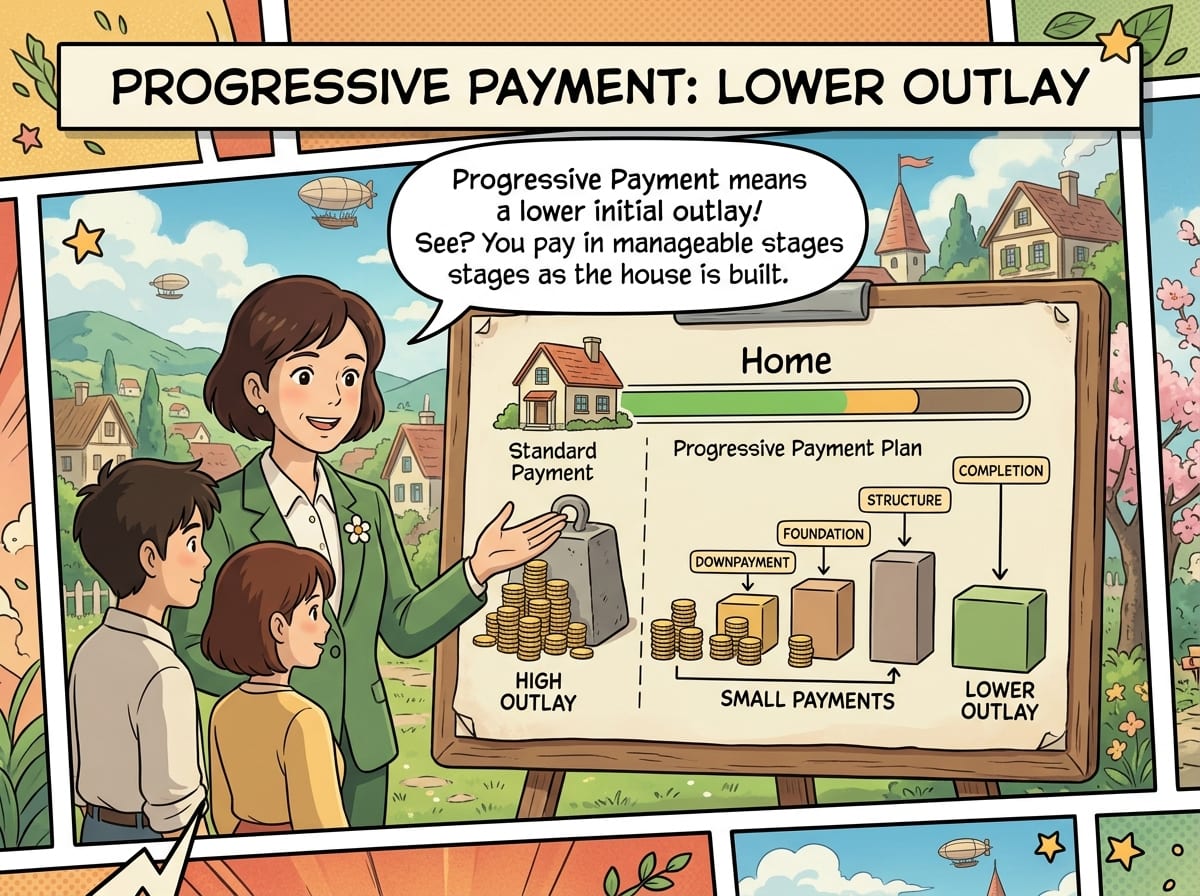
There is one line you will hear at every new-launch preview, and it is usually the line that closes the sale.
“You only pay as it is built. It is much easier on your cash flow than a resale.”
It is repeated so often that almost nobody checks it, and it is half true — which is the most durable kind of wrong. Progressive payment does save real money. It also costs money in a place people forget to look, and the second number is about four times the first.
So we ran both purchases month by month. Same price, same 75% loan, same mortgage rate, same day of decision. One buys an existing home and moves in. The other buys off plan and rents while it is built. Both need a roof over exactly the same months, which is the part most comparisons quietly drop.
First, the schedule is not the developer’s choice
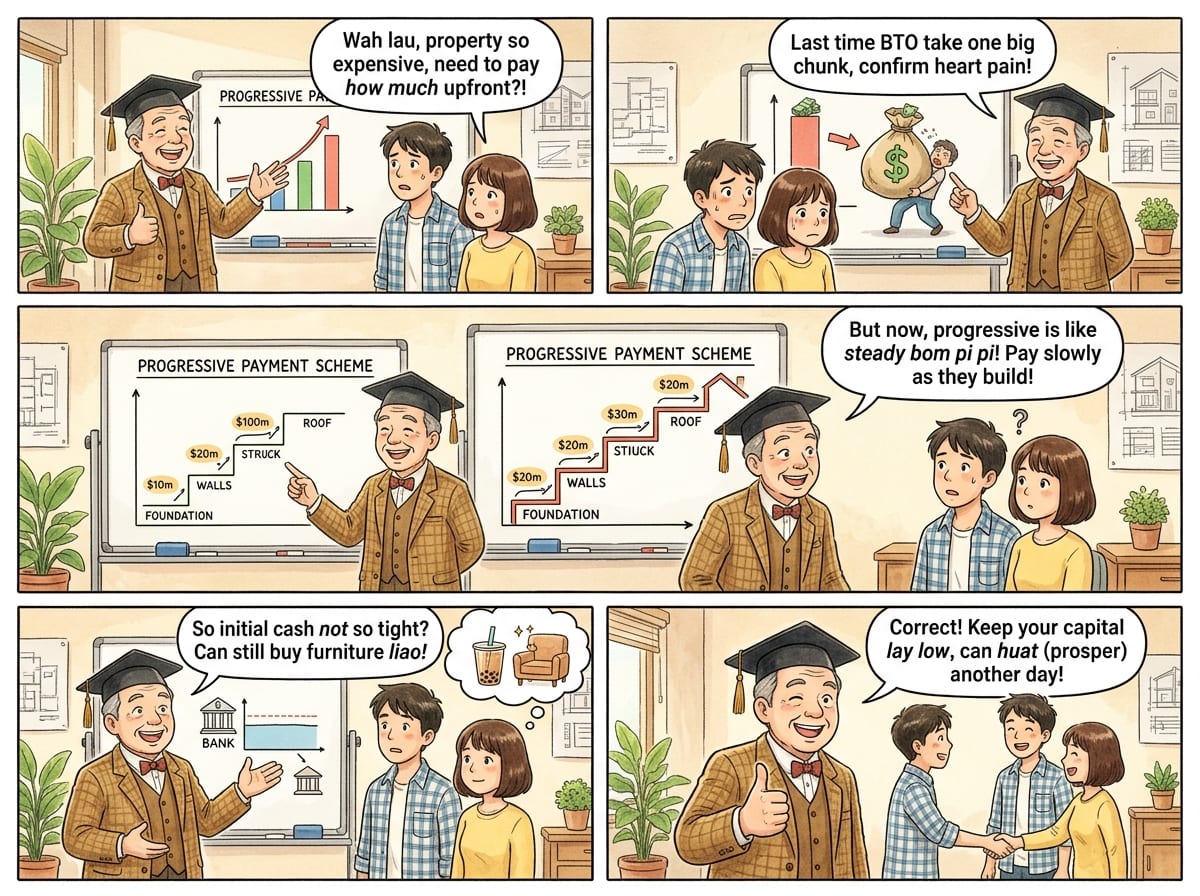
Worth knowing before anything else: the instalments are set in law, identically for every uncompleted private home in Singapore. They are in the Housing Developers Rules, in the prescribed sale and purchase agreement, at clause 5.1.
| When | Share of price |
|---|---|
| On signing, within 8 weeks of the option — inclusive of the booking fee | 20% |
| Foundation and pile caps completed | 10% |
| Reinforced concrete framework completed | 10% |
| Partition walls completed | 5% |
| Roofing completed | 5% |
| Door and window frames in position; wiring, plastering and plumbing done | 5% |
| Car park, roads and drains completed | 5% |
| Temporary Occupation Permit — the keys | 25% |
| Final payment | 15% |
Two details the popular version gets wrong. The commonly repeated schedule says “brick walls”; the rule says partition walls. And the first 20% is inclusive of the booking fee, not on top of it.
One more that almost nobody mentions: of that last 15%, only 2% goes to the developer. 13% goes to the Singapore Academy of Law as stakeholder — 8% released once the building’s Certificate of Statutory Completion is issued, and the final 5% held until the Final Payment Date, which is twelve months after you get vacant possession. That last slice is your defects retention, and the law holds it rather than the developer.
Problem one: the first cheque is bigger
Start on the day you decide, because that is when “easier on cash flow” is supposed to bite.
To hold a new launch you pay a booking fee of 5%, in cash, on the spot. To hold a resale unit you pay an option fee of 1%, and the other 4% about two weeks later when you exercise.
On a S$1.5 million home that is S$75,000 on the day, against S$15,000. The new launch asks for five times as much money on the first afternoon, and the minimum cash portion — the part CPF cannot cover — is 5% either way, so there is no offsetting relief.
Problem two: the lighter window is about six months wide
Run the cumulative cash out and the picture is not a trend, it is a brief dip.
The resale buyer completes around month three and hands over the rest of their 25% plus stamp duty in one go. From that moment until roughly month eight, the new-launch buyer is genuinely behind on cash — at the widest, by about S$70,700.
Then the foundation instalment lands, and the rent keeps landing every month, and from about month nine the new-launch buyer is permanently ahead on cash out and never goes back. The window in which the pitch is visibly true is roughly half a year, in the middle of a purchase that runs the better part of a decade.
Problem three: it is not your money being staggered
Here is the part that is genuinely counter-intuitive, and it is the reason the belief survives.
You put down 25%. The bank lends 75%. The bank does not disburse until your own money is exhausted — so your 20% at signing, plus 5% of the 10% due at the foundation stage, and that is your entire equity gone. On our timeline the foundation instalment lands around month nine, well under a year in, on a building that is a hole in the ground.
Everything after that is the bank’s money going out in stages.
So progressive payment does not spread out your contribution at all. It spreads out the loan. The thing buyers picture — their own savings trickling out gently over three years — is not what happens. What trickles is the borrowing, and that is precisely why the saving shows up where it does.
What it saves, and what it costs
Because the loan is drawn in stages, you are paying interest on a fraction of it for years. That is a real saving and it deserves to be counted.
Over the 54 months from decision to final payment, on a S$1.5 million home at 1.6%, the new-launch buyer pays about S$28,000 of interest. The resale buyer, carrying the full loan from month three, pays about S$72,300. The staging saves roughly S$44,300.
Now count the other side. The resale buyer moves in at month three and stops paying rent, having written three rent cheques. The new-launch buyer writes forty-four — from booking through to a month past the keys.
Money that does not come back, over the same 54 months
Two buyers, both needing somewhere to live, both paying S$1,500,000 at 1.6% on a loan of S$1,125,000. Principal repayment is excluded on purpose: it is money moved, not money spent. Stamp duty is excluded too — it is S$44,600 either way, so it adds equal width to both bars and says nothing about the difference.
The new launch costs S$132,034 more — and the two halves of that pull in opposite directions. Staging the loan genuinely saves S$44,266 of interest. Renting while it is built costs S$176,300, about 4.0 times the saving.
- Build runs to 4½ years instead of 3½+171,521
- Base case above+132,034
- Mortgage rate 3.0% instead of 1.6%+91,775
- Mortgage rate 4.0% instead of 1.6%+62,329
- You live rent-free while it is built−44,266
Bars run left and right of the same centre line, so direction is readable without colour. The interest saving grows with the mortgage rate while the rent does not — which is why the new launch looks worse the cheaper borrowing gets, and why the one scenario that flips the sign is not about money markets at all.
Computed by us. The instalment schedule is statutory — Housing Developers Rules, First Schedule, clause 5.1 — and is the same for every uncompleted private home in Singapore. Rent is the median district gross yield applied to an equal home, S$4,300 a month here. The construction period is an assumption and is the largest input on the page: nothing is published, so we use 42 months to keys and 54 to the final payment, and show above what a year longer does. Interest is charged on the drawn balance only until the loan is fully disbursed. Both loans run 30 years; the launch loan simply starts later. Renovation, maintenance, property tax and agent fees are excluded from both sides.
Set principal repayment aside — that is money moved, not money spent — and the new launch costs about S$132,000 more over the identical window. The interest saving is real, and it is about a quarter of what the rent takes back.
The bit that runs backwards
Look again at the scenario strip above, because it does something you would not guess.
The higher the mortgage rate, the smaller the new launch’s disadvantage. At 1.6% the gap is about S$132,000. At 3.0% it narrows to S$92,000. At 4.0% it is S$62,000.
The mechanism is simple once stated: the interest saving scales with the rate, and the rent does not care about the rate at all. So the advantage progressive payment is sold on is worth least exactly when borrowing is cheapest — which is to say, in the market people have spent the last two years describing as a great time to buy off plan on easy instalments.
And the length of the build matters more than the rate does in either direction. Push completion out by a single year and the gap widens to about S$171,500, because every extra month is another month of rent with nothing offsetting it.
Where the belief is simply right
We are not debunking anyone, and there is a case where the pitch is correct as stated.
If you have somewhere free to live — with family, or in a home you already own outright — the rent term is zero, and the whole comparison inverts. The interest saving survives untouched and nothing eats it. On the same numbers the new-launch buyer comes out roughly S$44,300 ahead.
That is not a rounding error, it is the entire argument flipping sign. The belief is not false. It is conditional, and the condition is never said out loud in a showflat — partly because the person saying it has no idea where you currently sleep.
A second case cuts the same way: a resale unit bought with a tenant in place collects rent from day one, which the buyer can put against the instalment. That is a different purchase with different risks, but it belongs in the honest version of the ledger.
And cash out was never the right measure anyway
One more reason the belief feels true. By month 54 the two buyers have paid out within about S$6,000 of each other — the totals converge. But look at what each has to show for it: the resale buyer has built about S$503,500 of equity in the home, the new-launch buyer about S$377,400.
The new-launch buyer’s monthly number was smaller for years because they were not repaying any principal. A smaller payment that builds nothing is not a saving; it is a deferral wearing a saving’s clothes. Anyone comparing two purchases on the monthly figure alone is comparing the wrong thing, and the comparison always flatters whichever side is amortising least.
It is leverage, and leverage does not care which way prices go
The last thing to be clear about, because the cash-flow framing hides it completely.
Both buyers put down 25% and control a S$1.5 million asset. That is four times exposure to the price, and progressive payment does not reduce it by a single dollar. It changes when you begin paying to carry that exposure, and nothing else.
From roughly the foundation stage — under a year in — the new-launch buyer has their entire S$375,000 committed against a building that does not exist, at a price fixed by contract on the day they signed. The schedule keeps disbursing on construction milestones regardless of what the market does in the meantime, and there is no clause that lets you reconsider.
Run the arithmetic in both directions, because it is the same arithmetic:
- Prices rise 10% by completion → +S$150,000, which is +40% on the money you put in
- Prices fall 10% by completion → −S$150,000, which is −40% on the money you put in
- Prices fall 20% → −S$300,000, or −80% of everything you committed
Nothing in the payment schedule softens the second and third lines. And your exit clock is not the clock you think: Seller’s Stamp Duty runs from the day you buy, not the day you get keys, so on a three-and-a-half-year build most of the four-year lock is served before you have ever slept there.
That is not an argument against buying off plan. Plenty of people take that trade deliberately and are glad of it. It is an argument against taking it because someone described the instalments as gentle.
What this cannot tell you
The construction period is an assumption, and it is the biggest input on the page. There is no published standard, and it moves the answer more than the mortgage rate does. Your own sale and purchase agreement names a Vacant Possession Date — use yours, not an average of other people’s contracts.
We held the price equal, which is generous to the new launch. The same money buys noticeably less floor area new than existing, which is a separate cost we have measured elsewhere: what the entry gap costs in square feet, and why the gap is a poor guide to who wins on returns.
Renovation is excluded from both sides, and it is usually the larger bill on a resale unit. That cuts against the direction of everything above, and we have left it out rather than guess at it.
Rent is the median district gross yield applied to an equal home — about S$4,300 a month here. Yours will be whatever you actually sign, and it is the number the whole comparison swings on.
We assumed interest only on the drawn balance during construction. Some borrowers pay full instalments from the start, which shrinks the interest saving further. Both loans run 30 years; the launch loan simply begins later.
The boring version
Four things, and you can do all of them before you decide anything.
Get the Vacant Possession Date in writing, from the agreement. Not an agent’s estimate, not a portal’s guess. It is the input that decides the answer.
Multiply your current rent by the months to that date. That single number is most of the comparison, and almost no one computes it.
Ask your bank what it charges during construction — interest only on the drawn amount, or a full instalment. The two are not close.
Compare money that is gone, not the monthly payment. Stamp duty, interest and rent are spent. Principal is not. A comparison that mixes them will always favour whichever purchase is repaying least.
Then ask yourself the only question that actually flips the sign, which nobody in a showflat will ask you: where would you be living while it is built, and what does that cost you? If the answer is nothing, the pitch is true and you should take it seriously. If the answer is a lease, it is the largest number in your decision, and it has been left out of the sentence that sold it to you.
Sources, and where our numbers are soft
Sources
- Housing Developers Rules, First Schedule — the prescribed sale and purchase agreement. The instalment schedule is clause 5.1; the stakeholder treatment of the final 15% and the definition of the Final Payment Date are in the same form. Read at the current version as at 8 August 2026, and quoted with the statute’s own stage wording.
- Buyer’s Stamp Duty and Seller’s Stamp Duty, IRAS. S$44,600 is exact on a S$1.5m residential purchase under the rates effective 15 February 2023.
- Loan-to-value ceiling of 75%, and the 5% minimum cash portion on a first housing loan: MAS, as encoded in our own rules file and current at July 2026.
- Mortgage rate of 1.6%: our curated current-market default, drawn from broker-quoted packages. There is no public feed for promotional mortgage rates, so treat it as an indicative figure rather than a published one — which is why the article shows 3.0% and 4.0% alongside it.
- Rent: the median gross rental yield across our 26 private districts, computed from URA rental and resale transaction records for the twelve months to August 2026, applied to a home of equal value.
Where our numbers are soft
- The construction timeline is ours, not anyone’s data. We place keys at month 42 and the final payment at month 54, and distribute the intermediate stages proportionally. The statute ties each instalment to a physical event, not a date, and no schedule of typical durations is published. This assumption moves the result more than any other input, which is why a longer build is shown explicitly.
- The resale side has its own timing assumptions. We complete three months after the option is granted and exercise the option two weeks after granting it. Both are conventional rather than fixed by any rule, and both are negotiable in a real transaction — a longer completion shifts a little of the early cash out but does not change the direction of anything here.
- Holding the price equal is a simplification, and it favours the new launch. In reality the same budget buys materially less floor area new. That difference is measured in a separate piece and is not double-counted here.
- Rent is modelled as a yield on an equal home. A buyer who would rent something smaller or further out pays less, and the gap narrows accordingly. It does not disappear: at half this rent the new launch is still roughly S$44,000 worse over the same window.
- Interest-only during construction is the common arrangement, not a universal one. Where a bank charges a full instalment on the drawn balance, the interest saving shrinks and the equity gap narrows.
- Renovation, maintenance, property tax, agent fees and any rental income are excluded from both sides. Renovation in particular usually favours the new launch and we have not credited it.
- The equity comparison assumes both loans run 30 years. A shorter tenure on either side changes how fast principal is repaid and therefore the S$503,500 against S$377,400 figures, though not the direction.
- All of it is one price, one rate and one district. The arithmetic is general; the numbers are an illustration, and a reader’s own inputs will move them.
A note on what this is not. We are not telling you to buy or avoid a new launch, a resale unit, or property at all, and we take no view on any project, district or developer. The piece finds that a widely repeated claim is conditional rather than false, and says plainly which condition decides it. No product is named or recommended, and no price forecast is made anywhere: the price move examples exist only to show that leverage works identically in both directions. We build a free Singapore property decision tool, sell no property, mortgages or advice, carry no advertising, and earn nothing from any link on this page.
General information and education only. This is not financial, mortgage or tax advice and takes no account of your objectives, situation or needs. Property is illiquid and its transaction costs are large. Mortgage rates, stamp duties and lending rules change without notice, and your own sale and purchase agreement governs your payments — confirm anything load-bearing with a banker or mortgage broker before relying on it.