Your family will have the password. That is not the same as inheriting the shares.
Singapore abolished estate duty in 2008, so this feels like someone else’s problem. It is not. The American exemption stops at US$60,000 — about S$77,000 of shares — and Singapore, unlike Australia, Japan or the UK, has no treaty to soften it.
But my broker is in Singapore. Does that not protect me?
No — and this is the first thing almost everyone assumes, so it is worth settling before anything else. The exposure attaches to the asset, not to the account it sits in. Moving the same American shares between platforms changes the custodian and the login, not what you own. A Singapore-incorporated, MAS-regulated broker holding US shares on your behalf is a Singapore company holding US-situated assets. The assets are still American.
Same broker in both rows. The account is not what the rule looks at.
“Generally, no matter where stock certificates are physically located, stock of corporations organized in or under U.S. law is property located in the United States.”
— the Internal Revenue Service (IRS), the United States tax authority, in its own filing instructions
“Then can my family just sell it and move the money out?”
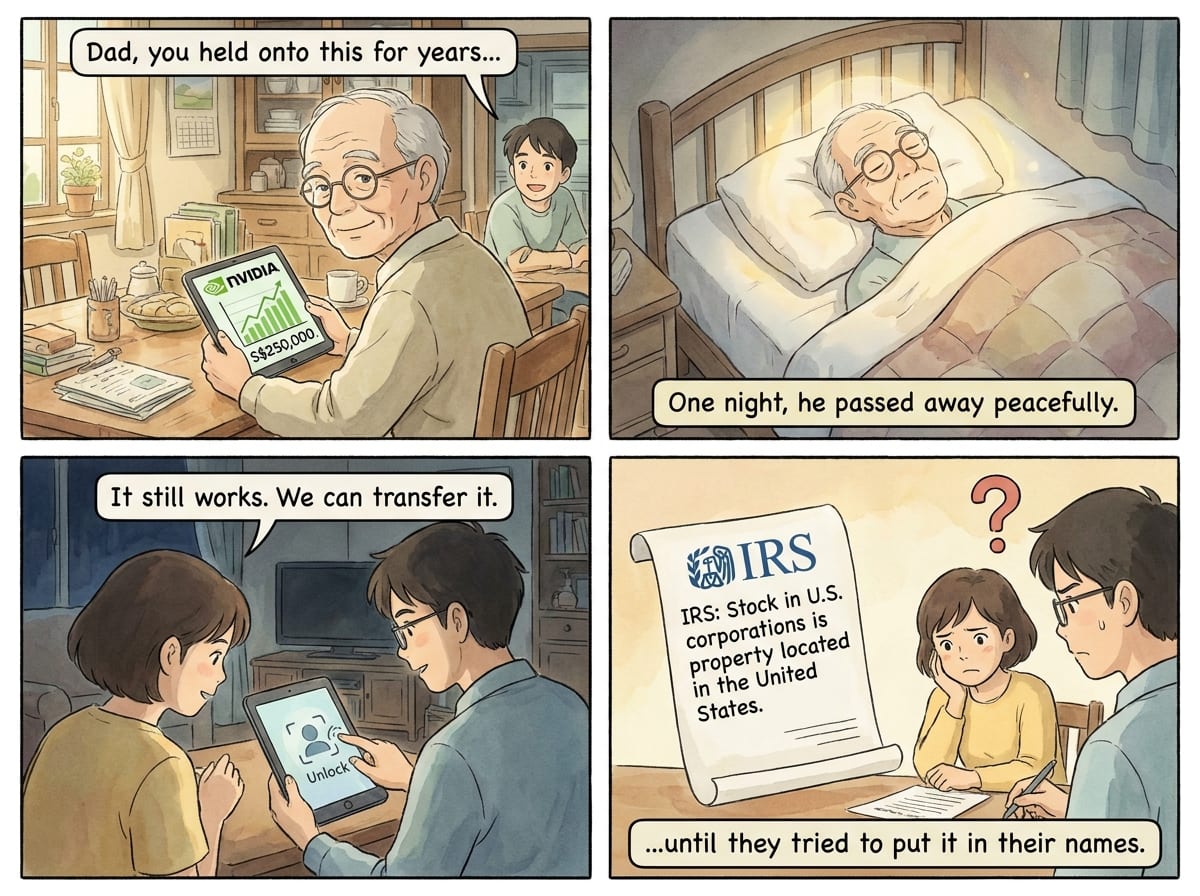
Picture a father who put a modest sum into Nvidia years ago, long before anyone at his table had heard of the name, and simply held on. He was never wealthy. The holding is worth around S$250,000 today. It sits in a brokerage account and his face unlocks it. One night he dies in his sleep, peacefully, at home. The family knows about the shares. The login still works. Nothing appears to be wrong at all — until they try to put those shares in their own names.
Practically, they can often sell. An account does not lock itself, and the IRS does not reach into your brokerage. That is what most people quietly assume, and it is why this is worth understanding before you rely on it.
It does not make the bill disappear. The tax is assessed on the value at the date of death, so it crystallised before anyone logged in. And under US law a person who receives assets passing outside probate — which is what a brokerage account normally does — can be held personally liable for the unpaid estate tax, up to the value of what they received. Where such an asset is liquidated without the tax being paid, that liability falls on the recipient, and a lien can attach to their own property.
So the plan does not remove the problem. It moves it onto your family, personally, in a foreign jurisdiction, at the worst imaginable moment. Separately, once a broker is notified of a death it can ask for a transfer certificate before releasing anything — and the IRS states that takes 12 to 18 months.
The same exposure, held two ways
This is the part that surprises people. The underlying companies can be identical — the difference is a legal fact about the security you hold, not about the businesses inside it.
Held through US-domiciled securities
Shares in US-incorporated companies, and funds domiciled in the United States, are US-situated property. Your estate may owe tax above the US$60,000 threshold.
Held through non-US-domiciled funds
A fund domiciled outside the United States is not US-situated property, even when it holds the very same American companies. What you own is a share in a non-US entity.
What changes your exposure
Three mechanisms. None of them is a recommendation, and each carries trade-offs that this tool does not price.
So what would it cost to hold this differently?
Removing that — exposure means holding the same companies through a fund domiciled outside the United States. But that also moves annual cost, dividend withholding, which platforms carry it, and whether it can sit in your SRS or CPF at all — some in your favour, some not. Worth seeing the whole picture rather than optimising for the scariest number on this page.
Why US$60,000, and why the rate climbs
There is no separately legislated US$60,000 allowance. A non-resident estate gets a unified credit of US$13,000 — and US$13,000 happens to be exactly the tax the schedule produces on US$60,000. The threshold is the arithmetic consequence of the credit meeting the rate table, which is why it has never moved with inflation.
| US-situated assets | Estate tax | Effective rate |
|---|
Computed from the statutory rate schedule, less the US$13,000 credit. Assumes no deductions and no treaty relief. The row nearest your own holdings is highlighted.
Sources — all primary, verified 18 July 2026.
Filing threshold (US$60,000, not indexed), the US$13,000 unified credit, the nine-month filing deadline and the quoted situs rule: IRS, Instructions for Form 706-NA. Rate schedule (Table A, 18% rising to a 40% top marginal rate): IRS, Instructions for Form 706. Treaty position: Singapore does not appear on the IRS list of estate and gift tax treaty countries, so no treaty relief is available.
Transfer certificate and its 12-to-18-month processing time: IRS, Transfer certificate filing requirements. Personal liability of a recipient of non-probate assets under IRC §6324(a)(2), and the lien that can attach to their own property: IRM 5.17.14 and IRM 8.7.5.
Exchange rate: refreshed automatically each time the site is published — from the MAS daily interbank series when available, otherwise the latest US Federal Reserve H.10 weekly release. The rate in use and its as-at date are printed beneath the calculator input above.
Deliberately not claimed: we do not assert that a broker will or will not release assets without a transfer certificate — the IRS pages do not address a custodian’s obligations. The treatment of jointly held accounts, and the duration of the §6324(a) lien, are likewise unverified and therefore not modelled.
Why this is worth an hour of your time. Not because the tax is enormous — for many people the exposed balance is small and the answer is to do nothing. It is because the people who deal with it will be your family, in a foreign system, in the worst month of their lives, working from whatever you left them. Knowing the number now, and telling someone where the account is, costs you an evening. Finding out the way the family above did costs considerably more.
Any company named on this page is an illustrative example of a US-situated asset, used to explain the rule. It is not a recommendation to buy, hold or sell anything, and nothing here should be read as a view on that company.
General information and education only: this is not financial, tax or legal advice, and it takes no account of your objectives, situation or needs. It names no funds and recommends no products by design. Estate matters interact with wills, with assets in other countries, and with rules that change — this is an area where a qualified tax adviser or private client lawyer genuinely earns their fee, and a large exposed balance is a reason to have that conversation rather than defer it. Figures are computed from the sources above; verify the current position before relying on them.