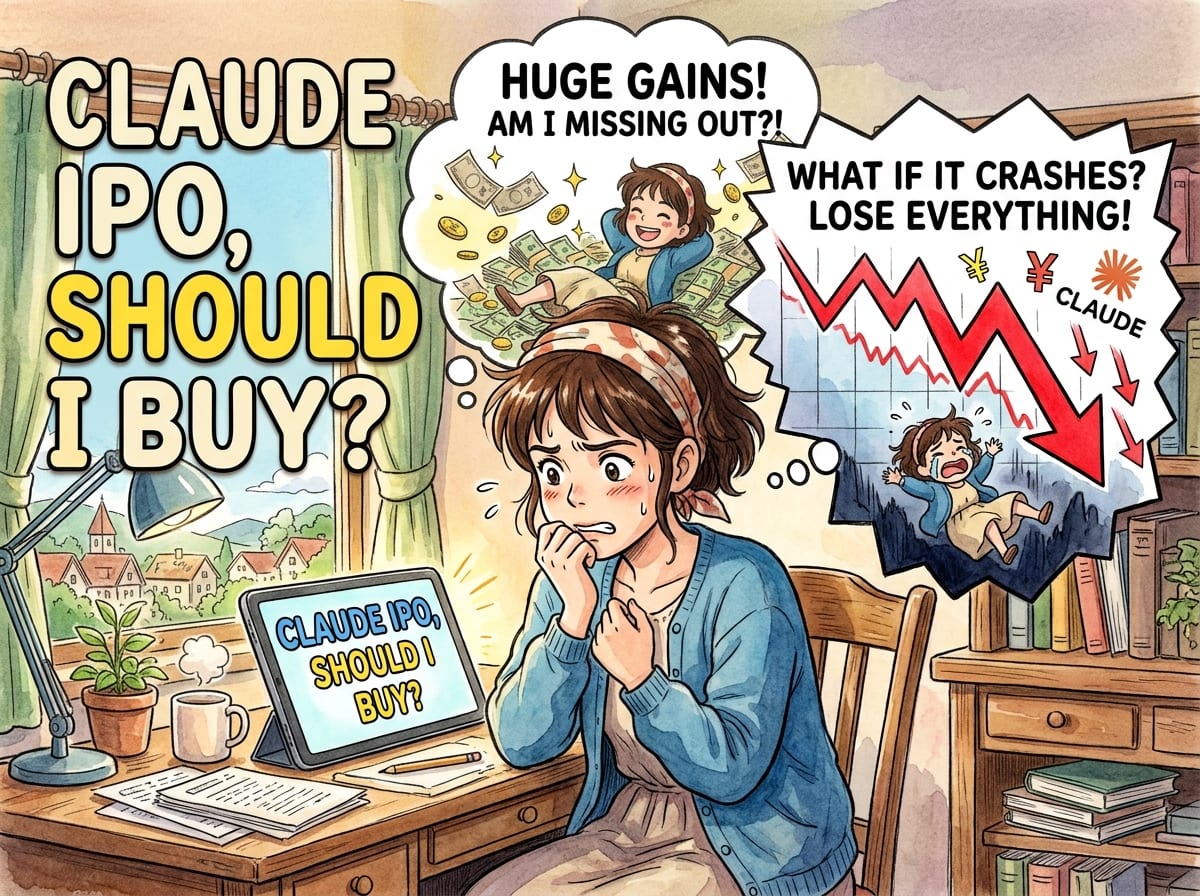
There are IPOs you watch because everyone else is watching.
Then there are IPOs you watch because they might change how the market values an entire sector.
Anthropic, for me, belongs in the second category.
Disclosure
This article is RE's personal opinion and commentary, not personalised financial advice — it does not consider your objectives, financial situation or needs. IPOs are high-risk, volatile, and can fall sharply after listing. We hold no affiliate, sponsorship or commercial relationship with Anthropic, SpaceX, or any company named in this piece.
SpaceX was the first fever. The story was obvious: Elon Musk, rockets, Starlink, Mars, reusable launch technology, and the largest IPO in history. It was spectacular, it was emotional, and it was genuinely hard for an ordinary investor to underwrite with confidence.
Anthropic feels different to me.
It isn’t just a story about the future. Claude is already inside the daily workflow of developers, analysts, founders, writers, researchers and companies — myself included. I use it. FI uses it. People who don’t use it yet may eventually be pulled in anyway, not because it’s fashionable, but because AI is quietly becoming part of normal productivity infrastructure.
The reason this IPO matters to me isn’t only Anthropic itself. It’s the ripple effect.
Several of the biggest US tech companies already have major economic or strategic exposure to Anthropic. Amazon has reportedly committed up to US$25 billion as part of a larger cloud arrangement; Alphabet (Google’s parent) has reportedly committed up to US$40 billion; Microsoft and Nvidia had earlier reportedly committed up to US$5 billion and US$10 billion respectively through strategic partnerships.
If Anthropic lists successfully and trades higher, that could lift sentiment across Amazon, Alphabet, Microsoft, Nvidia and the wider AI infrastructure chain. If it disappoints, it could puncture part of the AI premium currently priced into the market.
That’s why, to me, this isn’t just another IPO. It’s a market event.
1. Possible IPO valuation: what price range makes sense?
First, the honest starting point: there is no public ticker, no final IPO price, no confirmed share count, and no confirmed public float yet.
Anthropic announced on 1 June 2026 that it had confidentially submitted a draft Form S-1 to the SEC, and stated in the same announcement that the number of shares to be offered and the price had not yet been set.
So any “IPO price” discussion here has to be an IPO valuation range, not a real per-share price. For convenience, I’ll use ANTH as a placeholder ticker — swap it out once the real one is announced.
Anthropic’s last major private round reportedly valued the company at US$965 billion post-money. Reuters has also reported that Anthropic’s annual revenue run-rate topped US$65 billion by the end of July 2026, with a separate Reuters report citing a company forecast of US$190–200 billion in 2028 revenue.
Those are large numbers, and my own base case sits inside them rather than above them: US$1.5–2.0 trillion.
A lower number might feel like the banks left money on the table. A higher one could still happen if demand gets silly. But at US$1.5–2.0 trillion, the IPO would already be pricing Anthropic as one of the most important companies in the world.
RE’s IPO valuation scenarios
| Scenario | Implied IPO valuation | Implied multiple on US$65b revenue run-rate | Estimated public float | Implied IPO raise |
|---|---|---|---|---|
| Conservative | US$1.2t | ~18.5x | 3–6% | US$36b–72b |
| RE’s base case | US$1.5t | ~23.1x | 3–5% | US$45b–75b |
| Hot deal | US$2.0t | ~30.8x | 3–5% | US$60b–100b |
| Frenzy pricing | US$2.4t | ~36.9x | 3–6% | US$72b–144b |
The public float is only an estimate. As a reference point, SpaceX sold about 556 million shares in its June IPO against roughly 13.2 billion shares outstanding — a float of about 4.2%. If Anthropic follows a similar mega-IPO structure, a 3–5% float is plausible.
Illustrative share price only
On a phone, the wider tables below scroll sideways.
Because Anthropic hasn’t disclosed a share count, nobody can know the actual IPO price per share yet. Here’s how the price might look under a few possible share-count assumptions — pure valuation math, not a prediction.
| IPO valuation | If 10b shares | If 12b shares | If 15b shares |
|---|---|---|---|
| US$1.2t | US$120 | US$100 | US$80 |
| US$1.5t | US$150 | US$125 | US$100 |
| US$2.0t | US$200 | US$167 | US$133 |
| US$2.4t | US$240 | US$200 | US$160 |
Who is sitting on potential paper gains?
Exact ownership percentages aren’t fully public. The table below is a paper-uplift estimate based only on publicly reported investment amounts and valuation markers — it isn’t a complete cap table, and it isn’t realised profit unless those investors actually sell.
| Investor / group | Publicly reported investment marker | Reported entry valuation | Paper value at US$2.0t IPO valuation | Illustrative paper uplift |
|---|---|---|---|---|
| Amazon | US$5b immediate investment, up to US$25b total | ~US$380b for immediate tranche | ~US$26.3b on US$5b tranche | ~US$21.3b |
| Alphabet / Google | US$10b immediate cash commitment, up to US$40b total | ~US$350b for immediate tranche | ~US$57.1b on US$10b tranche | ~US$47.1b |
| Microsoft | Up to US$5b commitment via strategic partnership | Not fully disclosed | Not precisely calculable | Potentially material |
| Nvidia | Up to US$10b commitment via strategic partnership | Not fully disclosed | Not precisely calculable | Potentially material |
| Series G investors (incl. GIC, Coatue-led round) | US$30b Series G | US$380b post-money | ~US$157.9b for the whole round | ~US$127.9b |
| Series H investors | US$65b Series H | US$965b post-money | ~US$134.7b for the whole round | ~US$69.7b |
Amazon, Google, Microsoft and Nvidia aren’t just financial investors here — they’re infrastructure, distribution and enterprise channels. That’s what makes this IPO different from an ordinary venture-backed tech listing, to me. If ANTH trades well, it validates more than Anthropic. It validates the AI capex cycle around it.
2. Anthropic vs SpaceX: same fever, different business model
SpaceX was the event IPO of the year. It priced at US$135 per share, raised about US$75 billion, and listed under the ticker SPCX at a valuation of roughly US$1.77 trillion — opening at US$150 on Nasdaq and closing its first session at US$160.95, before sharp volatility set in.
But to me, SpaceX and Anthropic are very different kinds of bets.
SpaceX is capital-intensive, execution-heavy, and still tied closely to the market’s trust in Elon Musk’s ability to make impossible things real. It has real revenue, but investors are underwriting an extremely ambitious future. Morningstar reported that SpaceX’s IPO filing showed a US$4.9 billion net loss on US$18.7 billion revenue in 2025, and a US$4.3 billion net loss on US$4.7 billion revenue in Q1 2026.
Anthropic, by contrast, is already showing extraordinary revenue scale. Reuters reported that Anthropic projected US$10.9 billion in Q2 2026 revenue — more than double the prior quarter — and was reportedly on track for its first quarterly operating profit of US$559 million.
SpaceX vs Anthropic snapshot
| Metric | SpaceX | Anthropic |
|---|---|---|
| Ticker | SPCX | Not announced; ANTH used here as placeholder |
| IPO / expected IPO valuation | ~US$1.77t | RE’s estimate: US$1.5–2.0t |
| IPO price | US$135 | Not announced |
| Revenue marker | US$18.7b revenue in 2025 | US$65b annual revenue run-rate by July 2026 |
| Profitability marker | US$4.9b net loss in 2025 | Reported Q2 2026 operating profit of US$559m |
| Business model | Rockets, satellite internet, space infrastructure | AI models, Claude, Claude Code, enterprise AI, API usage |
| The question I’m underwriting | Can SpaceX justify a trillion-dollar-plus space and satellite empire? | Can Claude become default AI infrastructure for work? |
RE’s Opinion: To me, SpaceX has the bigger mythology, but Anthropic has the cleaner user-adoption story. I’m not saying SpaceX is a bad company — it’s probably one of the most important companies ever built. But as a public-market buy, it asks investors to accept a very high valuation on a capital-intensive, very complex business. Anthropic feels more understandable to me: Claude is already a real tool I can touch, test, use and build workflows around. For developers and knowledge workers, it isn’t science fiction — it’s already in the browser, the terminal, the workplace.
Short term, I expect the same fever: an IPO allocation scramble, an opening-day spike, then a painful shakeout when early buyers take profit. Long term, my own read is that Anthropic is the safer of the two for me to hold.
3. The “next Google” argument: how high could Anthropic go?
Claude feels, to me, like one of those technologies that could shape daily life for the next 20 years. Google felt that way in 2004.
When Google went public, it offered shares at US$85, sold 19,605,052 shares, and the offering valued the company at just under US$25 billion. Today Alphabet is worth roughly US$4.4–4.6 trillion, depending on the day — a rough 175x–185x increase from the IPO valuation.
Applying that same mental model to Anthropic is where the math gets exciting, and also dangerous. If Anthropic lists at US$2 trillion and somehow compounded like Google did after IPO, the implied future value would be absurd — around US$350 trillion. That’s almost certainly not realistic; the starting valuation is already too high for a clean Google comparison.
But the point of the Google analogy, for me, isn’t that Anthropic becomes 175x from here. It’s that some platforms become so embedded in daily life that the original IPO price only looks expensive at the very beginning.
If Anthropic followed Google’s post-IPO path
| Amount invested at IPO | If value rises 175x |
|---|---|
| US$1,000 | US$175,000 |
| US$10,000 | US$1,750,000 |
| US$100,000 | US$17,500,000 |
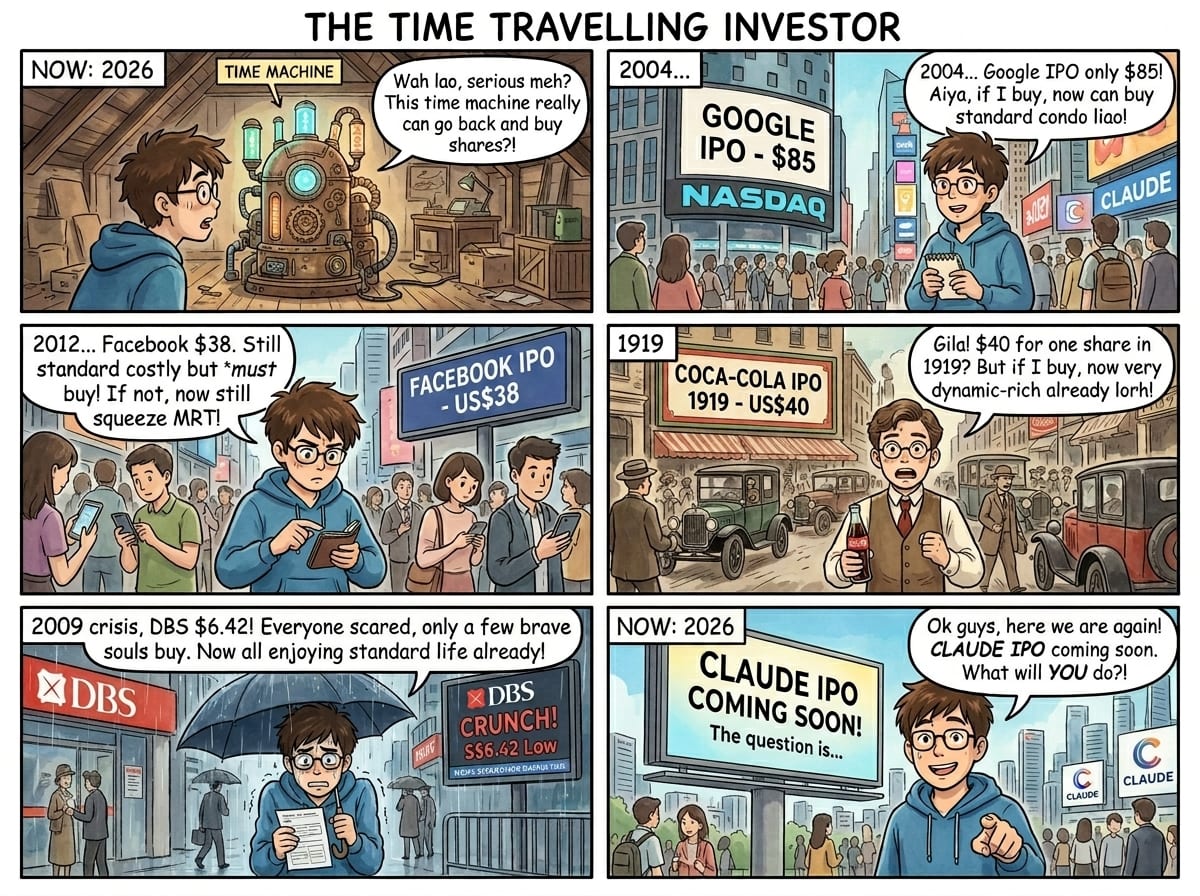
This is the part where I think about my kids. Not every investment needs to be traded. Some are bought because you may not get another chance to buy them this early. Google in 2004. Facebook in 2012 at US$38. Coca-Cola in 1919 at US$40. DBS during the 2009 crisis, when its own annual report later showed a 2009 low of S$6.42. Every one of those was uncomfortable at the time. They only look obvious later.
RE’s Opinion: If I have money I can genuinely set aside for a very long time, Anthropic feels like one of those generational positions I’d want to hold for my kids — not because it’s cheap, but because it might become infrastructure.
4. The contrarian view: China AI models and the price war
Now the risk. Anthropic will not get a monopoly.
Chinese AI models are becoming very good, very fast, and very cheap. Reuters reported that DeepSeek’s V4-Flash was estimated to cost about 3 cents per benchmark test, compared with US$3.15 for Claude Fable 5 — more than 100 times cheaper in that specific comparison. The Financial Times has also reported that OpenAI and Anthropic are facing a price war as Chinese rivals gain ground, with some cost-conscious customers switching to cheaper alternatives.
This isn’t theoretical anymore. Paramount Skydance reportedly placed monthly Claude spending limits on tech employees to control usage costs. Coinbase’s Brian Armstrong has also said the company was experimenting with Chinese open-weight models such as GLM and Kimi through its LLM gateway, while still encouraging engineers to pick the right model for the task.
So yes, the bear case is real:
- AI model pricing may keep collapsing.
- Customers may route cheap tasks to cheaper models.
- DeepSeek, Moonshot, Z.ai and other Chinese competitors may keep pressuring margins.
- Enterprise customers may become multi-model rather than Claude-only.
- Usage may keep growing while revenue per token falls.
But cheap doesn’t automatically win. Apple was never the cheapest phone. DBS was never the cheapest bank. Rolex was never the cheapest watch. Bloomberg was never the cheapest terminal.
In frontier AI, companies may not choose purely on token cost — trust, reliability, security, compliance, ecosystem, latency, model quality, enterprise support and political comfort all factor in. For sensitive enterprise work, American companies may still prefer Claude, ChatGPT or Gemini over Chinese models, especially where code, customer data, legal documents, healthcare records, financial data or government-related information is involved.
RE’s Opinion: To me, Chinese competition is the biggest single risk to this whole thesis — but cheap doesn’t always mean better, and in cutting-edge technology, trusted premium products can still win. The real question I keep coming back to is whether Claude becomes the Apple of AI. If it does, I think the market forgives a lot of valuation discomfort along the way.
5. RE’s conclusion
RE’s Opinion: I’m planning to buy — but I’m not going to behave like a tourist at a casino about it.
Anthropic is a better bet than SpaceX for me because I can actually understand the product. I use Claude. FI uses Claude. Founders, developers and businesses around me are starting to use it too. This doesn’t feel like a moonshot the way SpaceX is a moonshot — it feels like a real tool that people and companies already need.
There are only a handful of dominant AI platforms right now. If Claude stays one of them, Anthropic could become one of the defining companies of the next 20 years — that’s my own read, not a prediction I’d stake anyone else’s money on.
Short term, I expect the same price pattern as SpaceX: huge IPO demand, a first-day rally, possible profit-taking, sharp volatility, and long-term holders eventually separating from short-term tourists.
If I get IPO allocation at a reasonable valuation, I’d buy. If it opens 50–100% above the IPO price, I’d be more careful — I might still take a small starter position, but I wouldn’t chase it with money I need.
RE’s own framework — what I’d personally do, not a template for anyone else
| Situation | What RE would do |
|---|---|
| IPO prices around US$1.5t | Buy a meaningful starter allocation |
| IPO prices around US$2.0t | Buy, but size it carefully |
| Opens 50% above IPO price | Buy only a small starter position |
| Opens 100% above IPO price | Wait for the shakeout |
| Falls 20–40% after listing without business deterioration | Accumulate gradually |
| Chinese competition genuinely destroys pricing power | Reassess the whole thesis |
This isn’t a stock I’d flip blindly. For me, it’s one to own only if I believe AI becomes the next operating layer of work.
The question I keep asking myself isn’t whether Anthropic will be volatile — it will be. It’s whether I’ll look back in 20 years and think: “I had a chance to buy one of the two most important AI companies in the world, and I passed because the first-day price looked expensive.” That’s the question I had to answer for myself before deciding what to do with my own money — and it’s the one I’d suggest anyone thinking about this IPO ask themselves too, before making their own decision with their own adviser if needed.
RE’s Opinion (final): For me, Anthropic is worth buying — but only with long-term money, only with position-sizing discipline, and only after accepting that the first few months may feel stupid, euphoric and painful all at once. That’s usually how the generational ones begin, at least in my own experience.
Sources and where this is opinion, not fact — figures as reported through August 2026.
Sources
- Anthropic’s confidential S-1 filing, announced 1 June 2026, including the statement that share count and price had not yet been set: Anthropic’s own announcement.
- Anthropic’s reported valuation and revenue figures — the ~US$965 billion post-money Series H valuation, the US$65 billion annual revenue run-rate by end of July 2026, the US$190–200 billion 2028 revenue forecast, and the projected US$10.9 billion Q2 2026 revenue with a US$559 million operating profit: Reuters reporting.
- SpaceX’s IPO terms and financials — US$135/share, ~US$1.77 trillion valuation, the Nasdaq open/close on debut, and the reported net losses in the 2025 and Q1 2026 filings: Morningstar’s coverage of the SpaceX IPO filing.
- The Chinese AI pricing comparison and price-war reporting — DeepSeek V4-Flash’s estimated per-test cost against Claude Fable 5, and the broader pricing pressure on OpenAI and Anthropic: Reuters and the Financial Times.
- Enterprise cost-control anecdotes — Paramount Skydance’s reported Claude spending limits, and Coinbase’s Brian Armstrong on experimenting with Chinese open-weight models: public reporting and statements.
- Google’s 2004 IPO — the US$85 offer price, 19,605,052 shares sold, and the ~US$25 billion valuation at listing, against Alphabet’s current market capitalisation of roughly US$4.4–4.6 trillion: public IPO records and market data.
- DBS’s 2009 low of S$6.42 — DBS Group Holdings’ own annual report.
- The IPO valuation scenarios, share-price-under-different-share-count tables, and the paper-gains estimates are RE’s own arithmetic, built on the publicly reported figures above. They are not official company disclosures and should not be read as such — the real numbers will only exist once Anthropic files a priced prospectus.
Where this is opinion, not fact
Every line marked RE’s Opinion, the “RE’s own framework” table, and the overall Buy/Avoid framing throughout this piece are RE’s personal views and intentions — not financial advice, not a recommendation, and not a reflection of TheEnoughPoint.com’s institutional position. See the disclosure near the top of this article.