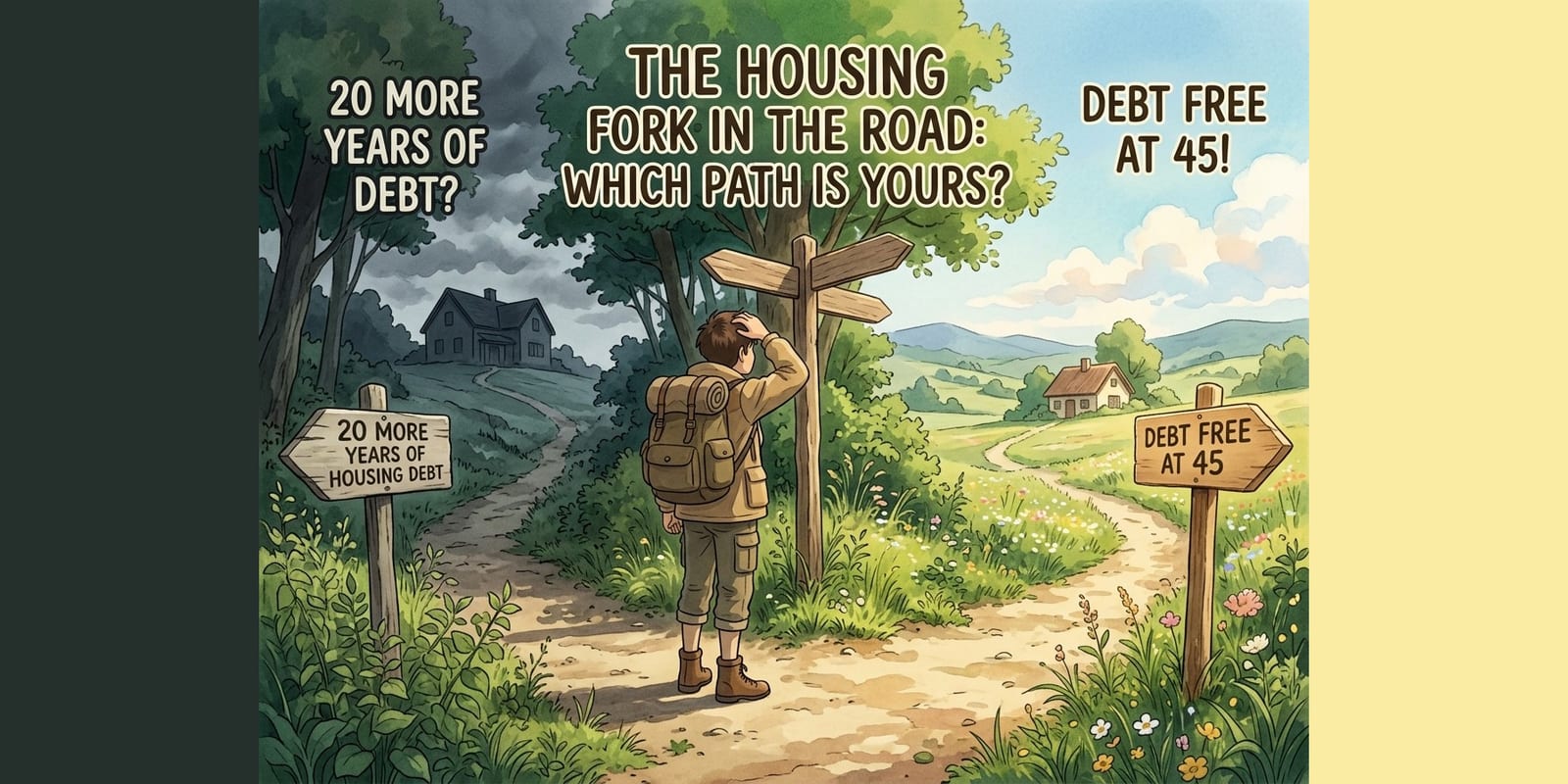
In Singapore, I am used to hearing about the next property upgrade.
A bigger flat. A better location. A condominium. Another bedroom for a future that always seems to require more space.
I hear much less about moving in the other direction — and feeling happier because of it.
That is why Thomas Ong’s recent move caught my attention.
According to CNA Lifestyle, the 57-year-old actor moved from a three-room flat into a 38 sq m two-room Flexi flat. He described the move as his happiest development of the year. The smaller space suits his needs and takes less time to maintain. Source: CNA Lifestyle
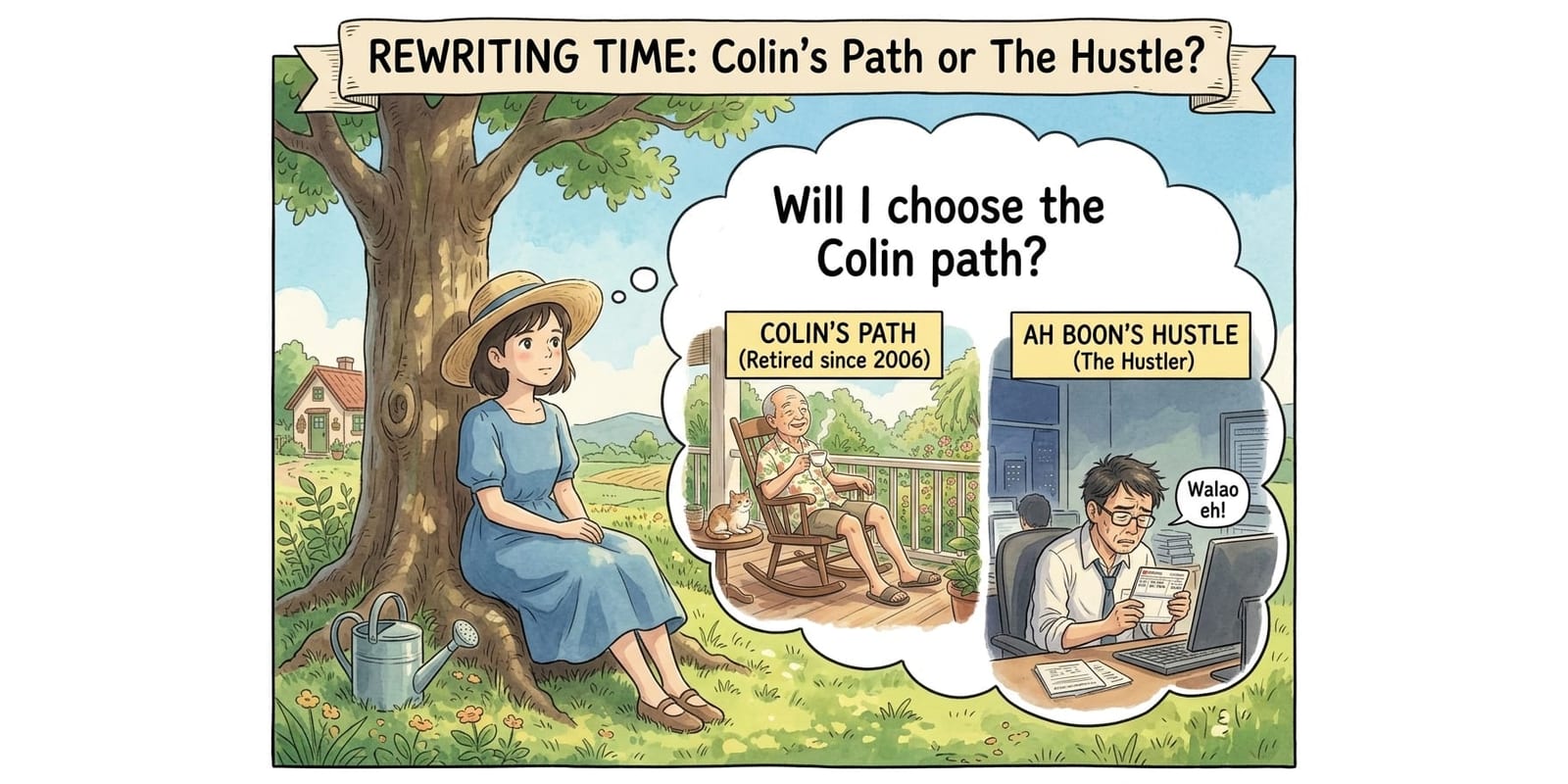
My first thought was not about the size of his living room. It was about Colin Lau. When I wrote about Lau in “Redefining Your Enough Point”, what stayed with me was his willingness to organise his finances around the life he wanted. Ong’s story brings me back to that same question.
Could a smaller home give me something more valuable than extra space?
Disclosure
This article reflects RE's personal perspective and opinion only. It is not financial advice, and individual circumstances, responsibilities and risks differ. We hold no affiliate, sponsorship or commercial relationship connected to anyone named in this piece.
Two different lives, one question about enough
CNA reported that Lau bought an ageing three-room flat outright for S$87,000 after losing his teaching job at 35. Renting out a spare room, receiving insurance payouts and keeping his expenses exceptionally low allowed him to stay outside conventional employment.
His reported monthly resources now total about S$2,500, including approximately S$900 in rent. His reported personal spending is below S$150 a month — an unusually low figure that I would never treat as a normal family budget. Source: CNA’s profile of Colin Lau
Ong’s circumstances are different. Mothership reports that he previously lived in a five-room flat, then a three-room flat, before buying his current home for S$140,000. Renovations cost under S$80,000. He has also sold his car, and health concerns influenced his decision to retire from acting. He hopes to support himself through social media content. Source: Mothership
That last detail matters. Leaving acting is not necessarily the same as no longer needing income. The reports do not disclose enough about his debts, assets or recurring income for me to declare him financially independent.
What I see is a shared willingness to reconsider how much home a satisfying life requires.
| Question | Colin Lau | Thomas Ong |
|---|---|---|
| What changed? | Job loss became the starting point for early retirement. | Health and lifestyle priorities accompanied a move away from acting. |
| What role does the home play? | Mortgage-free shelter and a source of room-rental income. | A smaller, more manageable place to live. |
| What supports the next chapter? | Reported rental income and insurance payouts. | Plans to earn through content creation; full finances are not public. |
| What do I take from the story? | Lower commitments can make modest income go further. | Less space can fit a chosen lifestyle better. |
These are different financial arrangements. I would not assume that the room-rental element of Lau’s approach can be copied into Ong’s housing situation. But both stories make me question the assumption that my next home must always be bigger.
The monthly payment behind the property dream
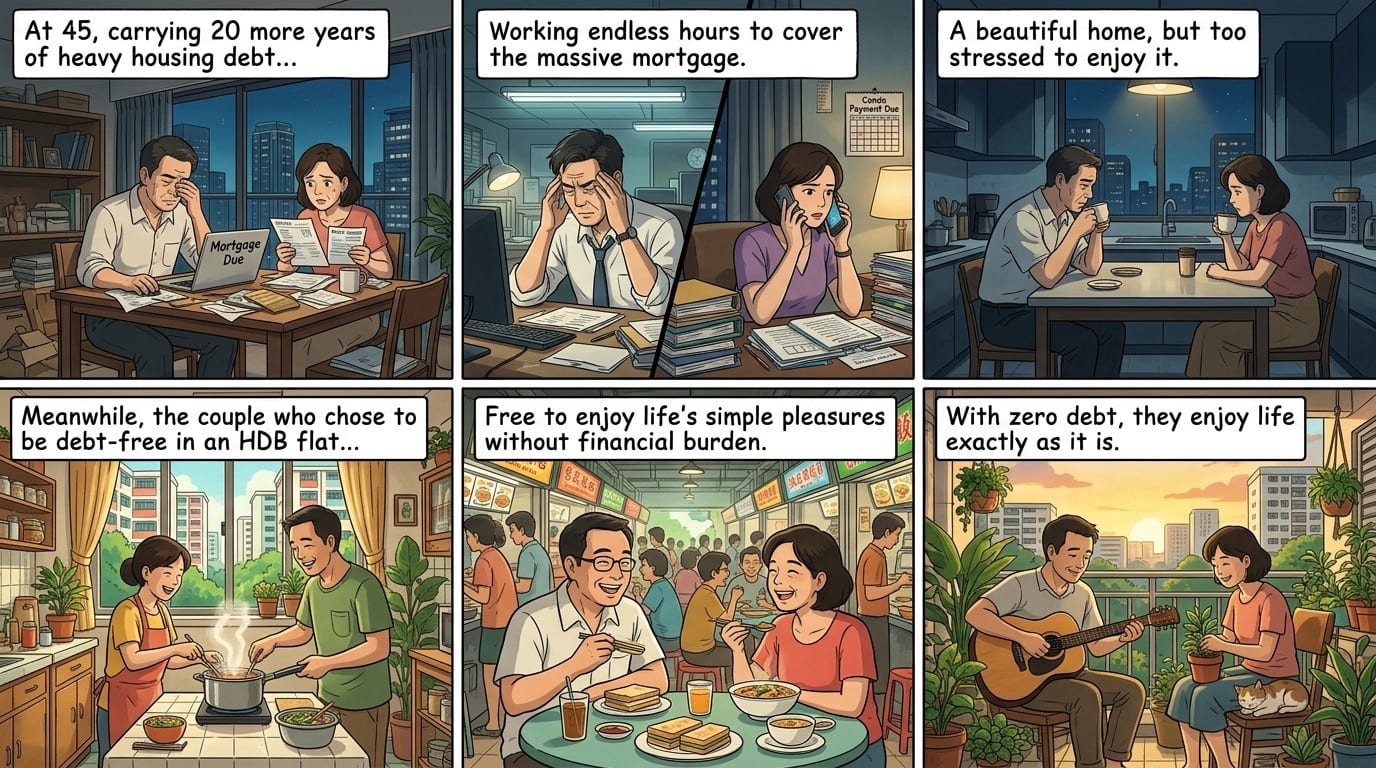
A home can provide security, comfort and a place for a family to grow. I understand why people value those things. My children are central to my own decisions — space that looks unnecessary on a spreadsheet may have real value in daily family life.
But I also want to acknowledge the other side of the purchase.
Every recurring commitment raises the amount of income I must keep finding. A mortgage does not adjust itself because I am exhausted. It does not disappear because I want a less demanding job, more time with my children or a year to try something different.
For a household with a substantial housing loan, that repayment can become one of the biggest constraints on flexibility. That is the part of the property conversation I want to examine.
What does an everyday family actually need each month?
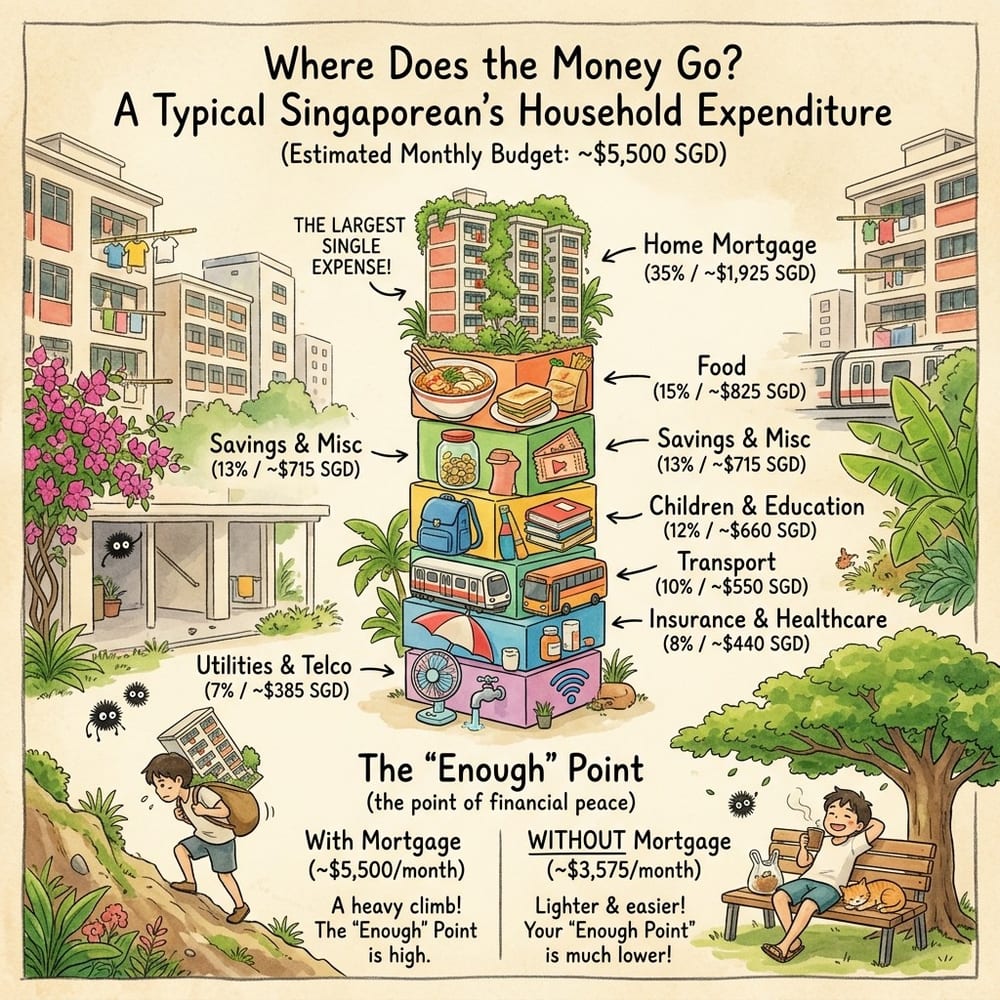
That sketch uses a smaller, lower-priced property than the one I calculate below — it is one illustrative shape, not a number to reconcile against my own worked example further down. It’s also a simpler household than the one I audited line by line in our six-month family spending review, where the gap between a tidy category breakdown and what a month actually costs became obvious fast.
There is no single “normal Singaporean family” budget. A couple without children, a family paying childcare fees and a household supporting elderly parents can have very different needs. Car ownership and healthcare can change the numbers dramatically.
For context, SingStat’s Household Expenditure Survey 2023 reported average monthly household expenditure of S$5,931, excluding imputed rent for owner-occupied homes. That is a historical average across resident households — not a recommended budget or a measure of what every family spends today. Source: SingStat
There is also an important accounting distinction: monthly mortgage repayments are excluded from the survey’s consumption expenditure on owner-occupied accommodation. Its housing figures therefore cannot tell me what percentage of families have a mortgage as their largest monthly payment. Source: SingStat’s explanation of household expenditure
To explore the effect, I would use an illustrative budget instead. The following is a hypothetical household of two adults and two school-age children, using public transport, buying a S$2 million property with a S$1.5 million mortgage over 25 years. I assume 75% financing, subject to eligibility, and a S$500,000 down payment before stamp duties and other purchase costs. This is a specific property scenario, not a claim about the typical Singaporean household or either man’s spending.
For the calculation, I use 2.08% interest per annum, a three-year fixed rate reported for OCBC on 2 October 2026. At that rate, a fully drawn S$1.5 million loan amortised over 300 monthly payments requires approximately S$6,416 a month, rounded to S$6,400 in the illustration. This is a recent reported rate used as a benchmark, not a personalised quote or a rate guaranteed for all 25 years; repayments can change after the fixed period. Rate reference: Tabla / The Straits Times, 2 October 2026
In plain English: borrowing S$1.5 million today costs about S$6,400 every month for 25 years, before a single other household bill is paid.
| Monthly commitment | With a mortgage | With no mortgage repayment |
|---|---|---|
| Mortgage repayment, whether funded by cash or CPF | S$6,400 | S$0 |
| Daily living: food, utilities, communications and transport | S$1,850 | S$1,850 |
| Family and protection: children, parents, insurance and routine healthcare | S$1,300 | S$1,300 |
| Home upkeep, personal spending and irregular-expense provision | S$850 | S$850 |
| Total monthly funding required | S$10,400 | S$4,000 |
The non-mortgage budget remains an assumed S$4,000, held constant to isolate the repayment’s effect. It is not a property-specific estimate of condominium maintenance fees, property tax or repairs; actual costs may be higher. This illustration excludes income tax, additional retirement saving, major medical events and large one-off purchases. A real plan would need to account for those separately.
Even with those limitations, the difference is substantial. The mortgage alone is larger than all the other commitments combined in this example. Using the rounded figures, removing it reduces the monthly funding requirement by approximately 62%, or S$76,800 a year, while leaving every other assumption unchanged. That is a reduction in funding required while the loan would otherwise be payable, not a permanent annual saving after its scheduled end.
That does not prove anything about 90% of Singaporean families. It shows why housing deserves serious attention in my own enough-point calculation.
A smaller monthly requirement can change the options
Suppose this hypothetical household could sustainably receive S$4,500 a month from sources other than its current full-time jobs.
Against S$10,400 of commitments, that leaves a S$5,900 monthly gap. Against S$4,000, it leaves a S$500 margin — before any costs omitted from the illustration.
That margin would still need testing against inflation, income interruptions and unexpected expenses. But the change illustrates something I find powerful:
The amount I need to earn can matter as much as the amount I manage to accumulate.
For me, reaching enough does not necessarily mean stopping work completely. It could mean accepting a less demanding role. Working fewer days. Building a small business without asking it to replace an entire salary immediately. A lower housing commitment could bring those choices closer.
But removing a mortgage is not free
There is a catch in the table: it shows the benefit of having no mortgage, but not the cost of getting there.
Paying off a loan consumes money that could otherwise remain available for emergencies or investment. Downsizing involves selling one home, securing another and paying the associated costs. Renovations can absorb part of the difference.
Mortgage principal also builds equity. The entire repayment is not an economic cost in the same way as interest or a utility bill, even though the full instalment still has to be funded. If repayments come from CPF, eliminating them does not automatically put the same amount of cash into my bank account each month.
Likewise, the difference between a selling price and a replacement-home price is not necessarily spendable cash. Outstanding debt, transaction costs and CPF housing refunds must be accounted for. CPF Board explains that refunds after age 55 first go towards the required retirement sum, with the remaining refund staying in the Ordinary Account. Source: CPF Board
So the question I would ask is more demanding than “Can I clear the mortgage?”
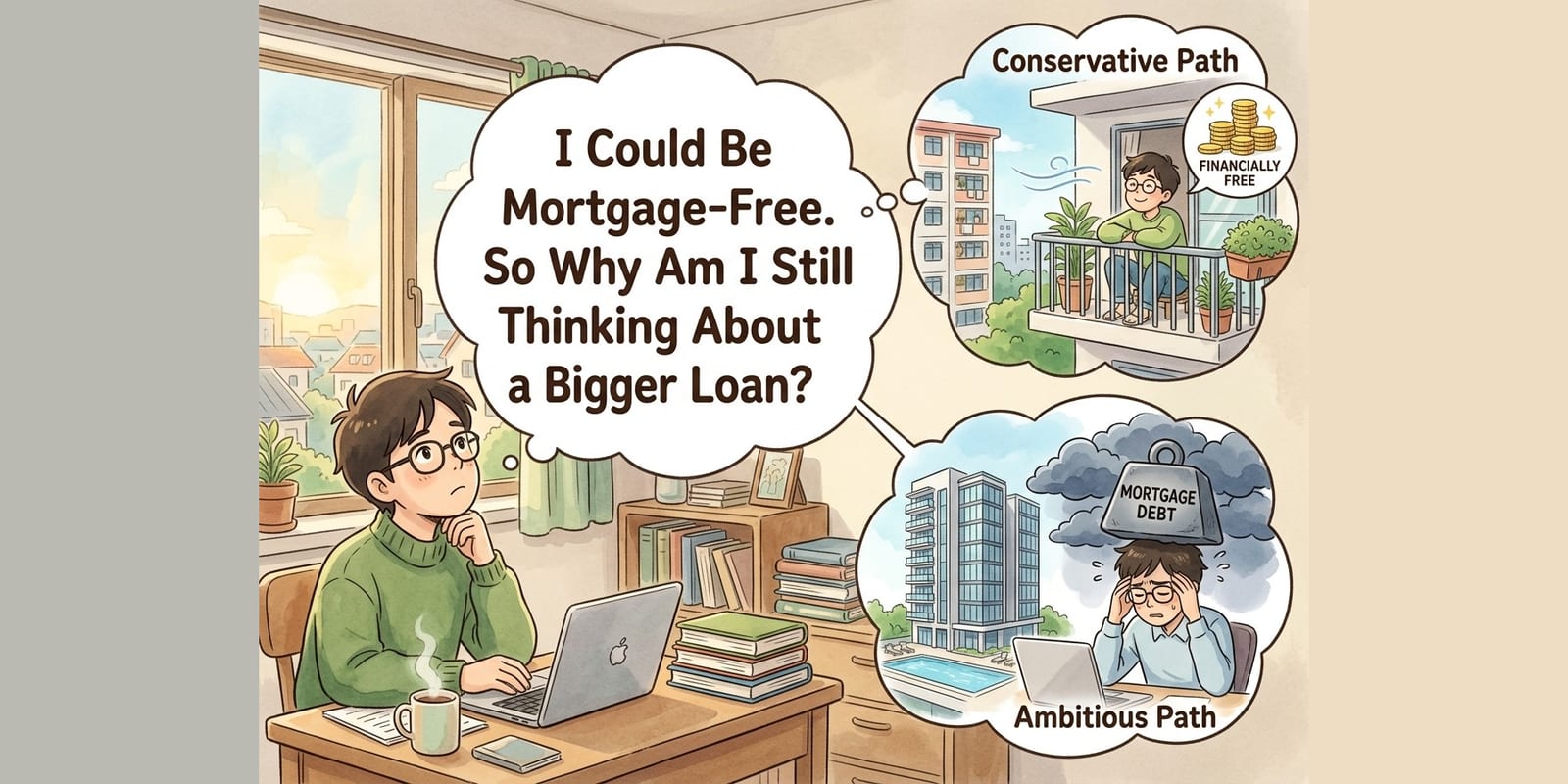
After doing so, would I still have enough accessible money and dependable income to live securely? I would want both a manageable home and enough flexibility outside it. It’s the same question I sat with in I Could Be Mortgage-Free. So Why Am I Still Thinking About a Bigger Loan?, and I still don’t think “mortgage-free” alone settles it.
What this means for TheEnoughPoint
This is why these stories fit so naturally with what FI and I are exploring at TheEnoughPoint. It’s the same question I put to readers directly in Where Is Your Enough Point? — housing is simply the loudest version of it.
I want to understand the life I am financing, not an enough point that keeps moving simply because my income rises or someone else buys a larger property. For me that includes my children, family responsibilities, enjoyable experiences and room for uncertainty — it will not look like Lau’s life or Ong’s, but I can still learn from their willingness to question an accepted direction of travel.
That is also why I find personalised calculators more useful than a single universal retirement number: I want to see what changes when housing costs fall, work income reduces, children’s needs change or healthcare costs rise.
My conclusion is narrower than “everyone should clear their mortgage and retire.” For a household carrying a substantial housing loan, reducing or removing that commitment — while preserving adequate savings and income — can bring its enough point meaningfully closer. The freedom comes from the whole arrangement working, not from the mortgage alone.
A smaller home, or a changing definition of success?
Two personal stories do not establish a national trend. I cannot tell from them alone whether more Singaporeans are choosing this path, or why. Still, I find the question worth asking.
If more people begin choosing smaller homes and lower commitments, would I see financial strain and exhaustion — a desire to stop running because the race has become too demanding? Would it resemble what people call China’s 躺平, or “lying flat”? Or would I see a cultural shift in home ownership, where success is measured less by the property acquired and more by the life it allows?
Perhaps those motives can coexist. If a smaller home gave you more control over your time, would it feel like giving something up — or finally reaching your enough point?
This article reflects RE’s personal perspective and is not financial advice. The household budget is hypothetical. Housing choices depend on individual finances, family needs and applicable rules.
Sources: CNA Lifestyle’s profile of Thomas Ong; Mothership’s report on Thomas Ong’s downsizing; CNA’s profile of Colin Lau; SingStat Household Expenditure Survey 2023; SingStat’s explanation of household expenditure; Tabla / The Straits Times mortgage rate reference, 2 October 2026; CPF Board on housing refunds after 55.