Staying alive is expensive. Being happy has optional upgrades.
I have a fairly basic theory about life: stay alive, and try to enjoy being here.
Before anyone brings religion, philosophy or an eighty-slide psychology presentation into this, yes, I know there is more to it. This is RE’s operating manual, not the final answer to human existence.
For many of us, the early instructions look familiar. Finish school. Find work. Earn money. Build a career. Upgrade something. Discover that the upgraded thing now needs insurance, maintenance and a subscription.
Repeat until further notice.
The route is less tidy now. Some people build businesses while studying. Others earn through freelance work, gigs or livestreams. The job title changes, but the question underneath often doesn’t: if I stop doing the thing that pays me, what happens next?
That is where FI and I begin when we talk about an enough point.
The question behind the number
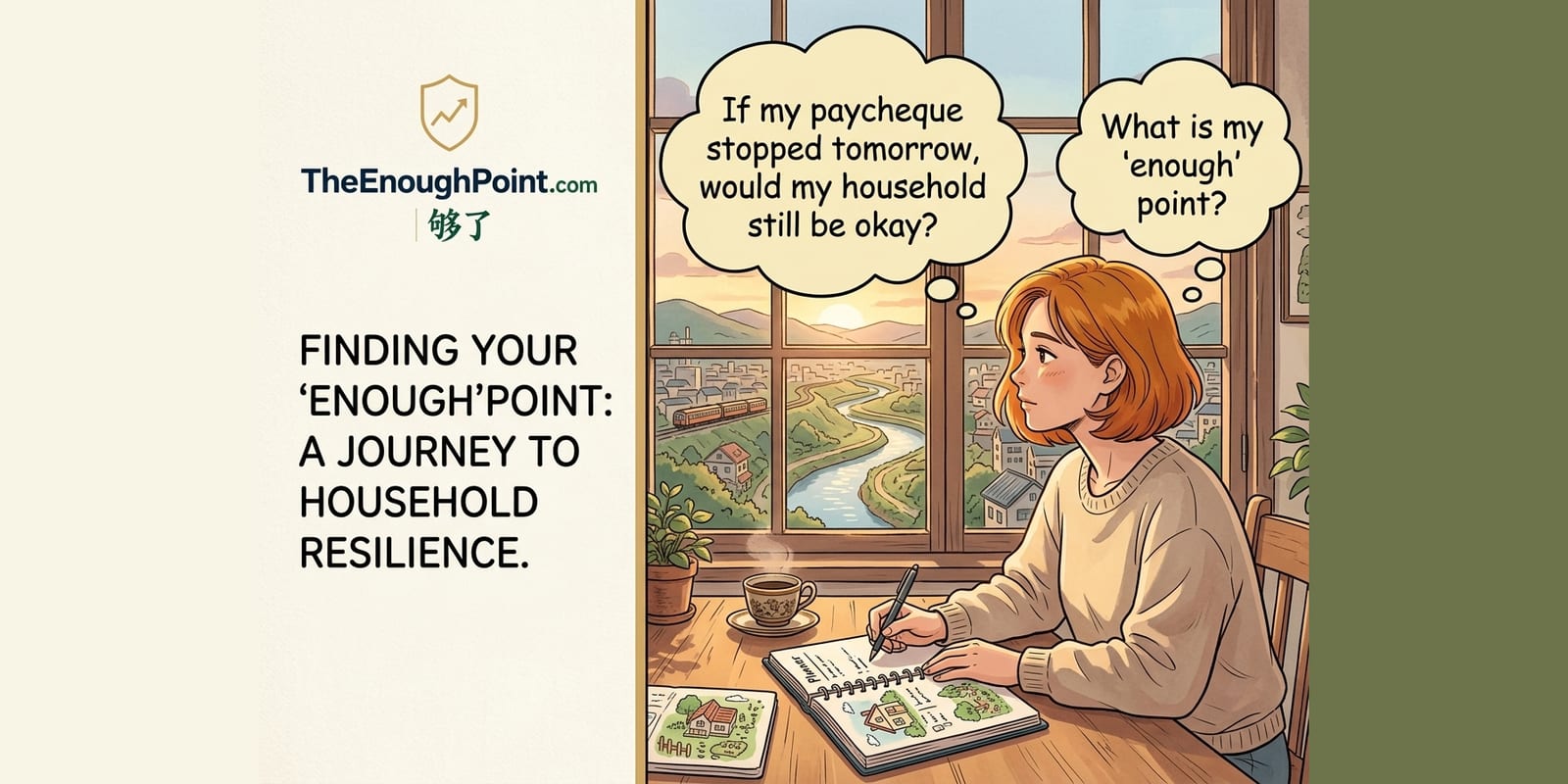
If my paycheque stopped tomorrow, would my household still be okay?
Not just me. The people who depend on me, too.
By “paycheque”, I don’t only mean a salary deposited by HR. It could be the money from a business I personally run, the freelance projects I complete, or the livestream I cannot cancel because apparently my electricity bill also has followers.
And by “okay”, I don’t mean surviving until Friday by finding loose change in the sofa.
I mean being able to support the life and responsibilities I actually have, without needing the next round of work income to keep everything upright.
In the definition FI and I use, reaching enough does not require quitting. I might continue working because I enjoy building things, meeting people or having a reason to change out of my home clothes.
The difference is choice. Money is no longer the reason I have to show up.
Two columns and one slightly uncomfortable switch
The starting arithmetic is simple:
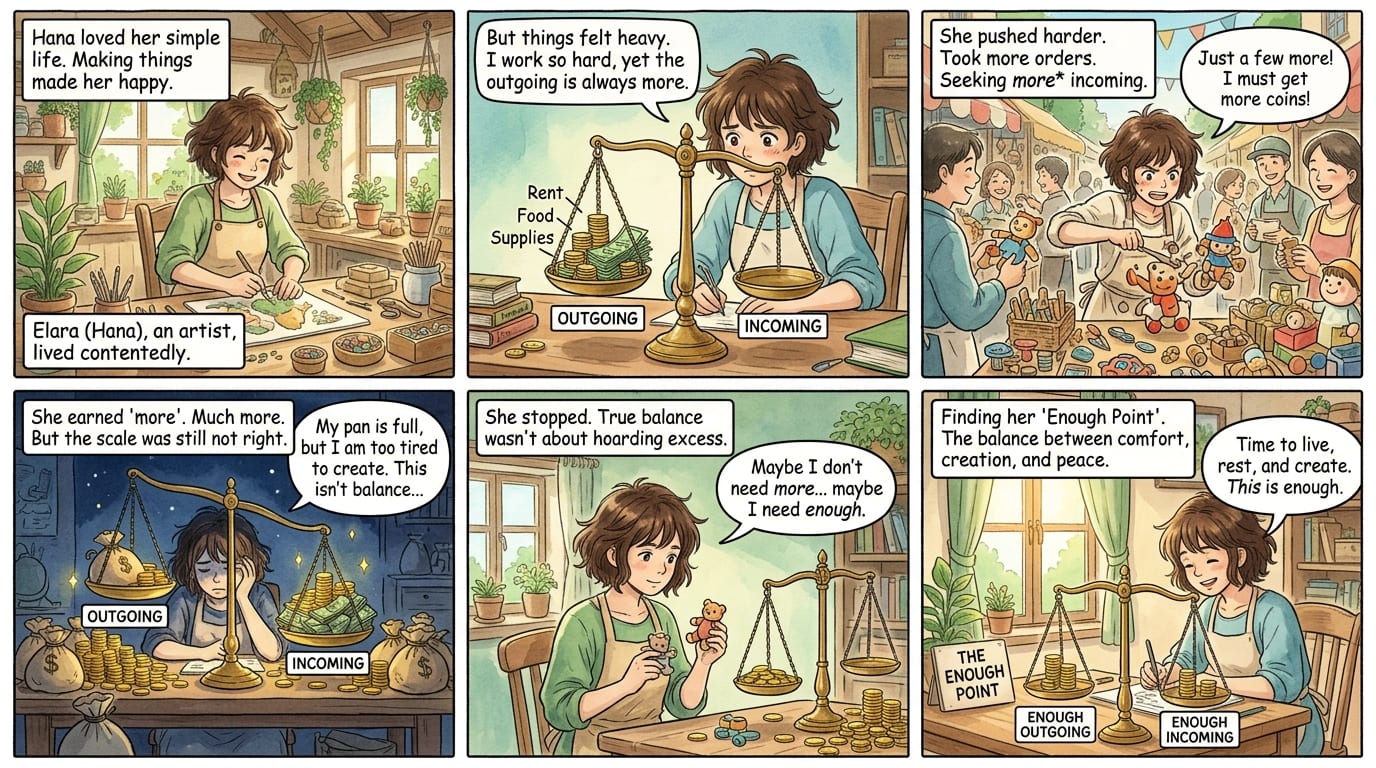
Monthly money coming in − monthly money going out = monthly surplus or shortfall.
A positive number is useful. But if my salary is doing all the heavy lifting, it tells me my current arrangement works. It does not tell me I can stop working.
So the tool below asks a second question: what remains when work-dependent income disappears?
I can list my income sources and expenses, then switch between As things are and If I stopped working.
A salary would normally disappear in that second view. So would gig income if I stopped doing the gigs. Calling something “side income” does not make it independent of my time. Unfortunately, renaming the spreadsheet column is not a retirement strategy.
Our side-income article makes a related distinction: an extra source of money can expand choices without replacing full-time income.
For each income source, I can decide whether it would genuinely continue without my work. That deserves an honest answer, especially if I own a business. A business that needs me every morning has not necessarily agreed to fund my afternoons off.
RE'S INTERACTIVE NOTEBOOK
The Enough Point Check
What changes when the paycheque stops? Start with an example, then make the numbers your own.
Enter monthly amounts in SGD. Mark income that would continue without your work. That does not mean it is guaranteed or permanent.
2 Fine-tune your monthly picture Type an amount or drag a slider. Your totals update as you go. Press the button below to reveal your result.
Money coming in SGD 0.00
Money going out SGD 0.00
Don't forget these costs
What should I count?
- Insurance payouts mean recurring cash received, not policy coverage or the sum assured. Check the payout end date.
- Use gross rent with costs under expenses, or net rent without counting those costs again.
- Use income available after business costs. Account for tax once, not twice.
- Divide annual bills by 12. Include costs for people who depend on you.
- Withdrawals from savings are not recurring income here. This tool does not model assets running out.
Enter your monthly amounts, then reveal both scenarios.
IF I CONTINUE TO WORK
IF I STOP WORKING TODAY
Based on your entered monthly amounts only—not confirmation that you can safely retire.
AS THINGS ARE
Start with your household expenses.
Zero expenses isn't a useful enough-point test.
Balance while working—
Balance without work income—
A snapshot, not a resignation letter.
This does not model income reliability, inflation, investment losses, future expenses or how long savings last. It is not personalised financial advice.
Calculated in this browser; entries are not saved by this tool.
This is a monthly cash-flow snapshot, not a retirement verdict. It does not model how long savings last, investment losses, inflation or future changes in family needs.
What the result actually means
If the numbers work only while I keep working, that is not a failure. It is simply the current picture: I have a working-income surplus, not yet freedom from that income.
If the income that continues without my work covers my entered expenses, that is a more interesting starting point. In this simplified snapshot, those expenses are covered.
But I am not handing in a resignation letter because a bar changed colour.
Rental income can have gaps. Dividends can change. A payout might have an end date. A major repair does not politely arrive in twelve equal monthly instalments. And withdrawing my own savings is different from receiving income that keeps replenishing itself.
The tool makes one part of the question visible. It cannot promise that my plan will last for the rest of my life.
That is also why I want the outgoing column to include the boring things. Housing payments. Insurance premiums. Transport. Support for family. A monthly allowance for bills that arrive once a year.
Our family spending review looks at why irregular bills belong in the monthly picture too.
My subscriptions already know exactly where to find me. The rest of my expenses deserve the same attention.
There are two sides to this balancing act
Broadly, I can improve the picture by bringing more money in, spending less, or changing both.
The difficult part is that the two sides sometimes move together. Income rises. Expectations rise. A previous luxury quietly becomes a household necessity. Enough moves further down the road, waving cheerfully.
I don’t think every comfort is a mistake. The point of having money is not to spend life proving I can survive without using it.
But I do want to know which expenses buy something I genuinely value, and which ones I have inherited from comparison, habit or a very persuasive checkout page.
My enough point has to fit my life. Someone else’s spending pattern is not a moral examination I need to pass.
The part of early retirement that still amazes me
In Redefining Your Enough Point, I discussed Colin Lau’s story: keeping spending low and using rental income from a spare room.
I don’t see it as a universal template. Different households have different responsibilities, housing situations and tolerance for uncertainty. But the way he approached both sides of the equation is worth thinking about.
The part that gets me is the time.
I have been hustling, rustling and occasionally busting since 2009. The idea of spending years waking up without immediately needing to earn the next paycheque does something strange to my brain.
Morning coffee. No compulsory scramble. The question becomes, “What would I like to do today?”
My inbox has never asked me that. It usually starts with “gentle reminder”.
Enough is personal. The arithmetic still needs to be honest.
I don’t need this tool to declare me a winner. I need it to show me where I stand.
Maybe it reveals a bigger gap than I expected. Maybe it shows that a modest change matters more than another ambitious income target. Maybe I discover that my supposedly independent income still requires me to answer messages on a Sunday.
That is useful information, even when it is slightly rude.
In the next two instalments, I plan to share stories of two people close to me who reached what they consider their enough point in 2013 and 2019. I will keep their identities private. Their stories are less about impressive qualifications and more about the choices they made, the lives they wanted and the spending they were comfortable with.
Check back for our weekly articles, usually on Mondays and Wednesdays.
For now, I am starting with those two columns and one question:
If work income stopped, which parts of my life could carry on—and which still depend on me showing up?
That feels like a more useful place to begin than borrowing somebody else’s magic number.
RE’s Opinion: This article and tool are for education and personal reflection, not personalised financial advice. A monthly surplus alone does not establish long-term financial independence. Any real decision to stop working needs a fuller assessment of assets, liabilities, income reliability, future costs and the needs of dependants.