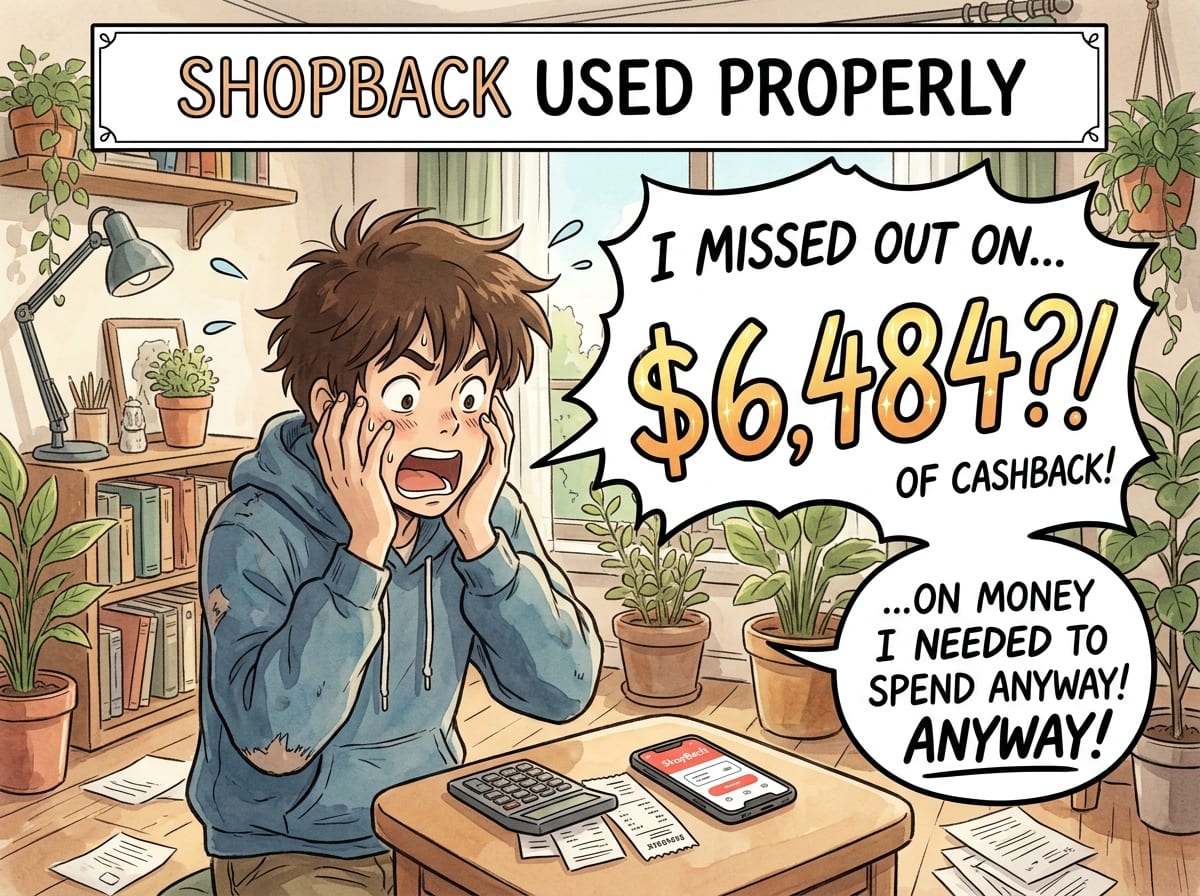
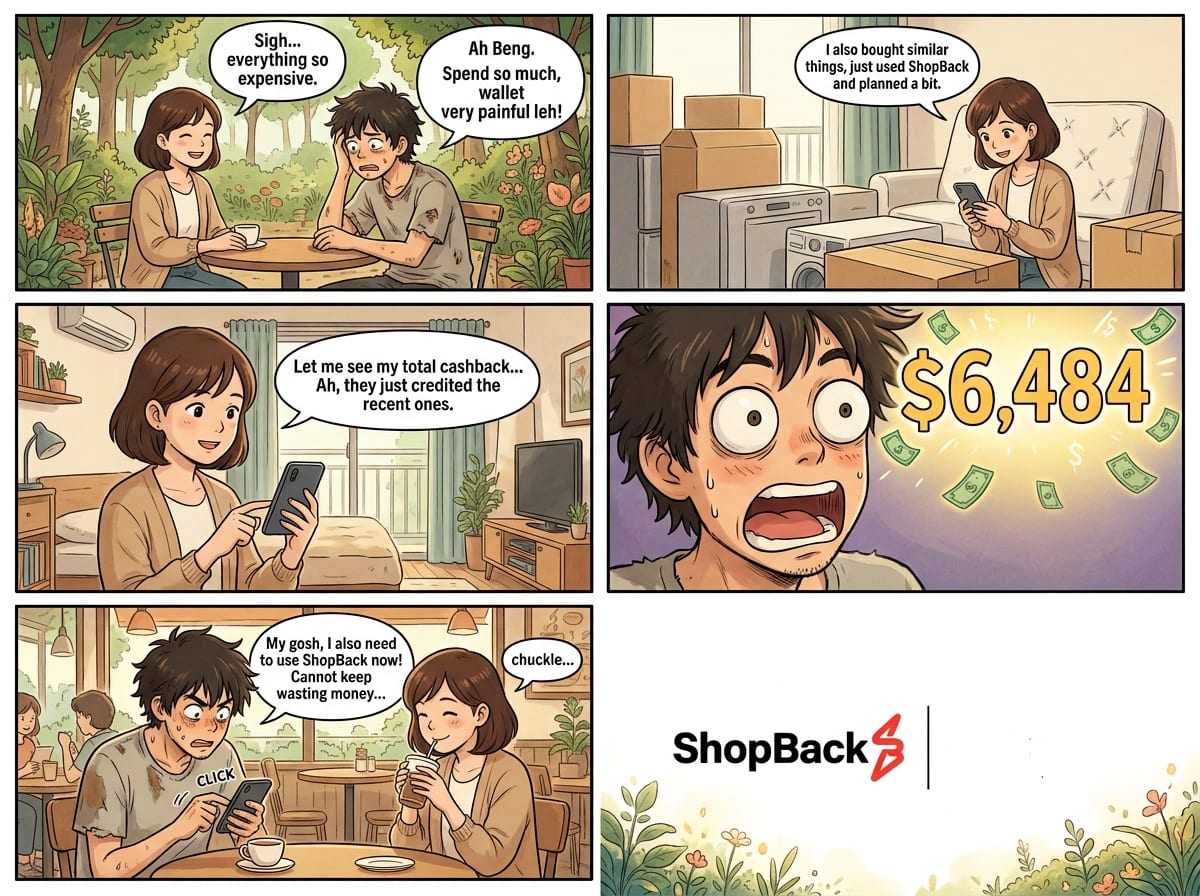
On most phones in Singapore there is a cashback app that was installed for one launch promotion and never opened again. Ours has paid for the habit of opening it: S$6,484.09 over the life of the account, S$4,541.03 of it already withdrawn to the bank.
Nothing about that number is clever. There is no arbitrage in it, no reselling, no hunting for deals. Every dollar came from spending that was going to happen anyway — school-holiday hotels, travel insurance, an iHerb restock, movie tickets, a plate of fried prawn noodles at the food court — routed through one extra click first. That click is the entire system.
Run the wrong way round, the same app is a spending machine. So before any rates or tactics, the rule.
The Rule Before the Rates
Cashback routes a decision. It must never make one.
The purchase comes first — the hotel is right, the dates are right, the price is fair against the alternatives. Only then does the question arise of which door to walk through on the way to pay, and the answer is: the one that refunds a slice.
Kept in that order, cashback is free money in the most literal sense available to a consumer. Reversed — browsing a cashback app to see what is worth buying — it stops being a discount and becomes a catalogue. S$10 back on a S$100 thing you did not need is not S$10 earned. It is S$90 spent. Every surface inside these apps — the flash deals, the challenges, the countdown timers — is built to reverse the ordering. Decline. The app is a door, not a shop window.
The Account, in Full
This is our dashboard as of this week, redrawn but to the cent:
One account, lifetime view
Our ShopBack dashboard, redrawn to the cent. As at 6 August 2026.
Drawn to scale. Paid out plus tracking is the lifetime figure to the cent: S$4,541.03 + S$1,943.06 = S$6,484.09.
Two of those numbers are worth understanding before you start.
Withdrawn is the only money that is real. We sweep the balance to the bank whenever cashback confirms, which is why “available to withdraw” reads zero. An app balance is an IOU from a company, not a deposit — sweep it.
Still tracking is a pleasant maybe, not a balance. Ours is mostly hotel stays that have not happened yet: cashback on travel confirms only after the trip is over, because the store will not pay a referral fee until it is sure it has really been paid. The merchant pages put numbers on it — Booking.com confirms up to 70 days after the trip, Trip.com, Agoda and Klook up to 120. A stay booked in July for October may not turn into withdrawable cash until early next year. Treat everything in that column as a bonus in transit — never as budget.
Where the Money Actually Comes From
There is no mystery funding this, and knowing the mechanics makes the whole thing feel less like a gimmick and more like what it is: a commission you are claiming back.
You are the referral fee
Stores pay for delivered customers either way. The only question is whether the customer collects a share.
- You decide the purchaseOn its own merits, at a price you have checked. Nothing here changes what you buy.
- You start at ShopBackApp or browser button — the click attaches the referral to you.
- The store pays a commissionA referral fee for a delivered customer. On travel, a large one.
- You get a shareShopBack keeps a slice and passes the rest back as cashback.
Online stores pay referral commissions for delivered customers — travel platforms especially, where commissions on a hotel booking are large. ShopBack is a referral broker. Start your purchase from its app or button and it delivers you to the store, collects the commission on your purchase, keeps a slice, and passes the rest to you. You are the referral fee, claiming your own share.
That is also the honest catch. The pipe that pays you is a marketing channel pointed at you — hence the rule above, which is the only defence the mechanics cannot give you.
Make the Click Automatic
The system fails at exactly one point: forgetting. Nobody forgets on purpose; they forget because remembering was manual. So make it not manual.
On desktop, install the browser extension — now listed as ShopBack – Cashback & Rewards on the Chrome Web Store (it was called ShopBack Button until recently, and there are listings for Edge and Firefox too; nothing for Safari). Land on a partner store and it tells you the current rate and offers one tap to Activate Cashback; at checkout it surfaces the promo codes that are safe to use; when a purchase tracks, you get an email saying so. The remembering is done for you at the exact moment it matters. An honest share of our lifetime total came not from discipline but from that popup.
On your phone, start inside the ShopBack app. Open the app, search the store, and it hands you into the store’s site or app with tracking attached. This matters more than it sounds: a purchase made by opening Lazada’s or Shopee’s app directly earns nothing, and the merchant conditions want each new transaction started fresh from ShopBack — for marketplaces, ideally with the cart assembled after you click through, not before.
That is the whole setup — about ten minutes, once. From then on the habit costs a few seconds per purchase, and only on purchases you were already making.
Big Tickets Do the Heavy Lifting
A percentage does not care how large the number under it is, and the click-through takes the same four seconds either way. So the money is not in remembering cashback on a S$12 order — it is in never, ever forgetting it on a big one.
One Saturday afternoon this July — the 25th, and the date was not an accident; more on that below — we sat down and placed the year-end holiday bookings in one sitting: a run of Trip.com hotel bookings inside half an hour, every one started from the app. One of them:
One booking from the 25 July sitting
Trip.com tracking detail, redrawn from our dashboard. The stay is in late October — the cash lands after it.
- Eligible purchase amount
- S$468.01
- Cashback tier
- Hotels & Homes
- Cashback rate
- 14%
- Cashback tracked
- S$65.52
Tracked — Trip.com confirms up to 120 days after the October stay
S$65.52, for one extra click on one booking. For scale: as we write, Trip.com’s everyday rate on that same hotels tier is 4.5% — the 14% we caught was an upsized window paying roughly three times that everyday rate. Booking.com (5.5% on stays right now), Agoda (4.5% on hotels) and Klook (6%) are all partners too, and between them the portals cover most of how Singapore actually travels.
One caveat belongs right next to that number, because it is the honest objection: a rate is not a price. Before any large booking, run the two-tab test below.
The same logic extends to the annual one-offs already sitting in your household calendar. Travel insurance is the cleanest example — FWD pays a flat amount up to S$35 per approved policy through the portal (new policies, not renewals, and bought on the website rather than the insurer’s app), and Klook’s travel insurance carries one of the highest percentage rates on the whole platform as we write. Our own history runs through FWD, Income and a Prudential–SingSaver campaign — cover we were buying regardless, bought through the door that pays.
And below the big tickets, the everyday layer — with expectations set honestly, because at today’s rates it is small change. Marketplace rates have thinned to the point of near-symbolism for existing customers (Shopee’s headline rate is for new customers; Lazada sits around 1% with a S$3 cap), and iHerb is a fraction of what it once paid. What still earns properly day to day is the in-store side: pay at a partner food court or hawker stall through the app’s Scan & Pay, or with a linked card, and the rate runs to about 5% — our ledger includes fried prawn noodles at Food Republic and a bowl of ah ma chi mian. One charming quirk: in-store cashback often lands as “Return Cashback”, which only confirms on your next visit to the same stall — loyalty, enforced by the mechanics. Golden Village tickets earn through GV’s website (not its app), or as discounted vouchers inside ShopBack. None of it is extra shopping. It is the shopping you already do, counted.
The Calendar Is Not Random
The 14% did not fall out of the sky. Upsized rates cluster, and the clusters follow a published rhythm — ShopBack’s own 2026 sale calendar and campaign guide lay most of it out:
When the upsized days land
ShopBack’s own published rhythm for Singapore, 2026. Bands are windows; dots are marquee days. There is no weekly pattern — the rest is ad hoc, shown on each store’s page.
Plus Day and the 15th apply to the paid tier only. Campaign days officially add roughly 1–5 percentage points to base rates; payday and marquee windows sometimes go far beyond that on selected stores — our 25 July booking ran at 14% against a 4.5% everyday rate.
Every month, the last week is the one to watch. Payday sales run from roughly the 25th to month-end — which is why our July bookings happened on Saturday the 25th. We were not being clever twice; we were being clever once, years ago, when the pattern went in the diary.
Every year, the fourth quarter is the deep end. The double-digit days — 9.9, 10.10, 11.11, 12.12 — sit inside ShopFest, ShopBack’s September-to-December festival, with Black Friday and Cyber Monday between the last two. The official guidance is that campaign days add one to five percentage points to base rates; the marquee days and payday windows sometimes go far beyond that on selected stores. June brings the birthday sale — up to 35% upsized in recent years — and the Great Singapore Sale window rides alongside.
And some upsizes are simply ad hoc. As we write, one travel platform is running an “up to 20%” window with a countdown on it. No weekday pattern survives checking — there is no magic travel Tuesday — so the practical rule is boring: a big booking that can wait a few days should wait, parked until month-end or the next marquee date, and the store’s ShopBack page (or the extension popup) tells you what is running today.
The strip above the calendar reads today’s date, so this page always knows how far the next window is. Park the booking, come back when it says live — or send this to the family chat before anyone books the year-end trip.
This section also lives at a permanent address: the Singapore cashback calendar — the same rhythm plus a dated log of the rates we have actually observed, kept current after this article ages. Bookmark that version.
The discipline caveat applies double here, because a countdown timer is precisely the surface designed to reverse your ordering. The calendar decides when an already-decided purchase happens. It must never decide whether.
The Rate Is Not the Price
Here is the objection that deserves to be taken seriously, because it is sometimes true: what if the price quietly rises once you arrive through a cashback link?
Independent spot-tests have caught exactly that. In one Singapore test, an Agoda room came out roughly S$75 dearer after clicking through — more than the 6.5% cashback gave back. In another, a Trip.com room priced at S$460 direct showed S$500 through the app; the S$22.50 of cashback left the buyer S$17.50 worse off. In the same tests, Booking.com and Expedia showed identical prices both ways. These are single spot-checks, not a study — but the defence costs nothing, so we run it on every booking that matters:
The two-tab test. Before clicking through, price the exact room, dates and cancellation terms in a private-browsing window, and screenshot it. Then click through from ShopBack and compare the final total, after taxes — not the headline rate. If the totals match, book through the app and take the cashback. If the through-price is higher, the screenshot has just told you what the cashback is really worth, which is sometimes less than zero.
Two more things an intermediary booking can cost you, mostly relevant to big-hotel loyalists: chains generally treat portal bookings as third-party bookings, so member pricing, loyalty points and elite-night credits usually do not post, and when something goes wrong you may be routed through the middleman’s support rather than the hotel’s. If you hold meaningful hotel status, price the direct member rate against the through-price-minus-cashback and let the totals decide. If, like most people, you do not — the two-tab test alone settles it.
Stack It Twice, Then Stop
Cashback from the portal is one layer. It stacks cleanly with a second: whatever rewards card you already hold. The store charges your card as normal, so card miles or card cashback accrue as normal, and ShopBack’s cut arrives on top. Two layers, zero extra effort, on the same purchase. Miles optimisers push this further — the app’s in-store payment keeps the merchant’s own category code, which certain bonus-rate cards reward — and The MileLion has mapped that rabbit hole for anyone who wants it.
Two cautions before anyone reaches for a third layer:
Outside promo codes can void the whole thing. ShopBack’s own rejection reasons include promo codes it did not issue — the store attributes the sale to the coupon site instead, and your tracking dies. Codes listed inside ShopBack are safe; a code from a random voucher site is a gamble against your own cashback.
So can rival browser extensions. Coupon and cashback extensions fight over the same attribution — the last one to touch the checkout wins. Run one cashback extension, or none; a coupon popup “helpfully” applying itself at payment is the classic silent killer of a tracked purchase.
And on the app’s paid tier: ShopBack Plus is arithmetic, not an upgrade. For about S$2 a month (first month free; the app shows the current fee at sign-up) it adds roughly half a percentage point to rates on top brands, 1.2× cashback on “Plus Day” (the 1st of each month) and member-only rates on the 15th. Half a point pays for S$2 only when about S$400 a month actually flows through the portal — a heavy booking month clears that easily, a quiet year never does. Do the division before paying for it.
Then stop. There is a fourth layer of optimisation out there — rate-watching across rival portals, miles-versus-cash arbitrage, multi-account juggling — and its hourly rate is terrible. The same goes for the app’s quests, challenges and games: pleasant sprinkles when they overlap with what you were doing anyway, and never a reason to buy anything. The entire point of this system is that it runs on habit, not attention.
What a Year of Routing Returns
Lifetime numbers flatter anything. The honest question is what a year of this is worth for a normal household, so put your own figures in:
What a year of routing returns
Your own figures, times the rates. The defaults are today’s base rates — edit them; upsized windows run higher.
≈ a proper family dinner out every quarter
Arithmetic, not a projection. Rates are per store and change constantly (these defaults are base rates as at August 2026); caps, exclusions and tracking failures all take their bite, and pending cashback is not money until it confirms.
For a family that books a holiday or two through the portals, insures its trips, and routes its ordinary online basket, the arithmetic lands in the hundreds per year — real, but not life-changing, which is exactly the right expectation to hold. This is spending hygiene, not income.
The Fine Print That Bites
Everything above works only if the tracking works, and tracking has rules. Community threads are full of people who learned them the expensive way; here they are for free:
- Make it one clean run. Click through from ShopBack, land at the store, check out — same session, same window. Wandering off to a price-comparison site or clicking a store’s ad somewhere else mid-checkout hands the attribution to someone else. Do the comparing before the click, not after.
- No outside promo codes, no rival extensions, ad blockers off — the three most common causes of rejected cashback, per ShopBack’s own support pages.
- Cancellations claw it back. Cancel the stay, lose the cashback — even one already showing as tracked. Nothing is yours until it confirms.
- Marketplaces have their own quirks. On Shopee you must buy from the seller you landed on, and the headline rate is for new customers — existing accounts earn a token rate. On Lazada, items already sitting in your cart before the click-through are excluded: click first, fill the cart second.
- Confirmation is slow by design. A purchase shows as “tracked” within about two to five days; confirming takes far longer — travel merchants publish 70 to 120 days after the trip. The store is waiting out its own refund window before paying a commission on you. Slow is normal, not a scam.
- If a purchase never tracks, the claim window is 7 to 30 days. The dashboard’s Report Missing Cashback flow opens a week after purchase and closes for good at day 30 — and the investigation itself can run up to 120 days. On anything large we keep the confirmation email until the cashback confirms; it is the evidence a claim stands on. Our own history says tracking is reliable, not perfect — file early, with the screenshot attached.
- Withdrawing is mildly annoying, on purpose. Minimum S$10 of confirmed cashback, to a Singapore-issued bank account only — no PayNow — capped at S$300 a day, fee-free, arriving within about ten calendar days. None of that is a reason to leave money in the app. Neither is this: an account left inactive for twelve months can see its cashback expire. Sweep on a schedule.
Three Pages Worth Bookmarking
Everything above reduces to three moments — activating the click, timing the big ones, and chasing the ones that fail. Each has a page behind it, and the point of a bookmark is that none of it has to be remembered.
The browser extension handles the first moment on desktop. It flags the rate when you land on a partner store and offers one tap to activate, which removes the only step in this whole system that depends on memory.
Our cashback calendar handles the second. It keeps the whole rhythm in one place — the payday window, the marquee dates, ShopBack’s own published calendar behind it — with a countdown to the next window and a dated log of the rates we have actually observed, kept current after this article ages. It is a page to open before a large purchase rather than after one — the 14% in the booking above was a calendar date, not luck.
The tracking-issues checklist handles the third. Claims open seven days after purchase and close permanently at thirty, so this is the one people find too late. Worth knowing where it lives before it is needed.
What It Adds Up To
S$6,484.09 has not changed our lives, and it was never going to — anyone selling cashback as a path to anything is selling. What the number actually proves is smaller and more useful: that a few seconds of routing, applied without exception to spending that was happening anyway, compounds into a family weekend’s worth of money year after year, indefinitely, for no ongoing effort.
That is what value living means in practice: not deprivation — intention. Decide the spending on its own merits. Then take the slice that was always on the table, because it was yours to begin with.
Sources, and where our numbers are soft
Sources
- Account figures — lifetime earnings, withdrawn, tracked, and the Trip.com booking detail (S$468.01 at 14%, S$65.52 tracked) — are read directly from our own ShopBack dashboard, 6 August 2026.
- Tracking conditions, rejection reasons and the missing-cashback process: ShopBack’s support article on tracking issues and on withdrawals. Withdrawal minimum, daily cap and payout timing also per SingSaver’s operational rundown, updated July 2026.
- The price-inflation spot-tests: The Frankly’s two-part hotel test (Agoda dearer through the portal, Booking.com and Expedia unchanged, July 2024) and a November 2025 Lemon8 test (Trip.com S$460 direct against S$500 through the app). Internationally, The Points Guy priced 134 itineraries across card travel portals and found average markups from under 1% to over 14% — different portals, same lesson: compare final totals.
- ShopBack Plus pricing and break-even arithmetic: The MileLion’s teardown (August 2024) — S$1.99/month against a roughly +0.5% boost.
- The in-store payment feature’s category-code behaviour, for the miles-inclined: The MileLion on turning offline spend into online spend (June 2025).
- Tracking-void conditions (ad blockers, outside codes, third-party clicks), the 7–30 day missing-cashback window and the 120-day investigation ceiling: ShopBack’s tracking-issues checklist and report-missing-cashback article, read 6 August 2026.
- Travel confirmation windows and rates, read off the merchant pages on 6 August 2026: Booking.com (5.5% stays, confirms 70 days after trip), Trip.com (hotels 4.5%, 120 days), Agoda (hotels 4.5%, 120 days), Klook (hotels 6%, 120 days), Shopee (headline rate for new customers; existing accounts a token rate), Lazada (around 1%, S$3 cap), FWD (up to S$35 per approved policy), Golden Village (4%, website only).
- The sale rhythm: ShopBack’s 2026 Singapore sale calendar (July 2026 — payday sales the last Friday–Sunday of each month; 9.9 through 12.12; Black Friday 27 Nov; Cyber Monday 30 Nov), its sale-calendar strategy guide (campaign days add roughly 1–5 percentage points), payday-sale explainer (May 2026), and press coverage of ShopFest’s September–December window. June birthday-sale upsizes per ShopBack SG’s own campaign posts, 2024–2025.
- Extension listing: ShopBack – Cashback & Rewards on the Chrome Web Store (updated 30 July 2026) and ShopBack’s browser-extension help article. In-store mechanics, Return Cashback and payment exclusions: Shop in-store via ShopBack. Withdrawals: Withdraw your Cashback and the fees guide (updated 2 July 2026). ShopBack Plus mechanics: official article. Twelve-month inactivity expiry: Cashback status issues.
Where our numbers are soft
- Rates change constantly. Every rate quoted here is as at early August 2026 and will drift; the lifetime total was earned across years of different rates. Rates can also be personalised to the account, so check your own logged-in rate, not a screenshot — including ours.
- The price-inflation tests are tiny samples. One hotel here, one room there — enough to prove the failure mode exists, nowhere near enough to say how often it bites. That is exactly why the two-tab test is framed as a habit, not a warning about any one platform.
- The upsized-day calendar is a pattern, not a promise. It is drawn from ShopBack’s own published 2026 calendar and past campaign coverage; ShopBack decides its campaigns, ShopFest 2026 had not been formally announced for Singapore as we wrote, and past cadence is a guide to when to look, not a guarantee of what you will find.
- A lifetime figure flatters. S$6,484.09 accumulated across years of an account; do not read it as an annual rate. The tool above is the honest per-year arithmetic.
- Our mix is not your mix. Our total leans heavily on travel bookings, which carry the fattest rates. A household that does not book travel online will earn materially less.
A note on what this is not. ShopBack has not paid for, seen, or influenced this piece, and links to it here are ordinary links, not referral links. The figures are from our own account, spent with our own money. We name the platform because the numbers are the platform’s — there is no product-neutral way to show a real dashboard.
General information and education only. This is not financial advice and takes no account of your objectives, situation or needs. Cashback rates, store lists and terms change without notice, tracking can fail, and pending cashback is not money until it confirms. Check current terms before relying on anything here.